Mayukha Govind Ram Elizabeth (1998) Page 1 of 3
Elizabeth (1998)
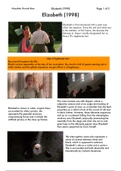
Elizabeth is first introduced with a pink rose
when she appears. Since the red and white one
is the emblem of the Tudors, the dynasty she
belongs to. Kapur visually designated her as
Henry III’s legitimate heir.
Idea of legitimate heir:
Recurrent throughout the film:
Playful colours especially on the day of her coronation, the church is full of guests wearing red or
white clothes and the global impression we get off her is of legitimacy.
This vision ternate one with despair, where a
subjective camera and a low angle shot tanding of
Elizabeth’s point of view, as a reminder that she feels
Elizabeth is shown in white, virginal dress,
powerless as a child in front of this crowd of old men
surrounded by white curtains, she
in black clothes. However, these alternate sequences
represents the peaceful and pure
end up on a sunbeam falling from the stained-glass
compromising forces and it reveals the
windows onto Elizabeth, physically dominating the
artificial privacy in the close up frames.
assembly from the stage and chair she sat on and
gives hops to the alternate specter since Elizabeth
then seems supported by God, himself.
The interrogation scene also represents a
sense of contrast between white and
black, which is supposed to enhance
Elizabeth’s role as a victim and a saviour.
She is surrounded and both physically and
theoretically by Catholic fanaticism.
Elizabeth (1998)
Elizabeth is first introduced with a pink rose
when she appears. Since the red and white one
is the emblem of the Tudors, the dynasty she
belongs to. Kapur visually designated her as
Henry III’s legitimate heir.
Idea of legitimate heir:
Recurrent throughout the film:
Playful colours especially on the day of her coronation, the church is full of guests wearing red or
white clothes and the global impression we get off her is of legitimacy.
This vision ternate one with despair, where a
subjective camera and a low angle shot tanding of
Elizabeth’s point of view, as a reminder that she feels
Elizabeth is shown in white, virginal dress,
powerless as a child in front of this crowd of old men
surrounded by white curtains, she
in black clothes. However, these alternate sequences
represents the peaceful and pure
end up on a sunbeam falling from the stained-glass
compromising forces and it reveals the
windows onto Elizabeth, physically dominating the
artificial privacy in the close up frames.
assembly from the stage and chair she sat on and
gives hops to the alternate specter since Elizabeth
then seems supported by God, himself.
The interrogation scene also represents a
sense of contrast between white and
black, which is supposed to enhance
Elizabeth’s role as a victim and a saviour.
She is surrounded and both physically and
theoretically by Catholic fanaticism.