
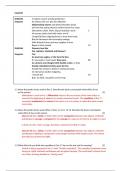
Macbeth
DUNCAN O valiant cousin! worthy gentleman!
Sergeant As whence the sun 'gins his reflection
Shipwrecking storms and direful thunders break,
So from that spring whence comfort seem'd to come
Discomfort swells. Mark, king of Scotland, mark: 5
No sooner justice had with valour arm'd
Compell'd these skipping kerns to trust their heels,
But the Norweyan lord surveying vantage,
With furbish'd arms and new supplies of men
Began a fresh assault. 10
DUNCAN Dismay'd not this
Our captains, Macbeth and Banquo?
Sergeant Yes;
As sparrows eagles, or the hare the lion.
If I say sooth, I must report they were 15
As cannons overcharged with double cracks, so they
Doubly redoubled strokes upon the foe:
Except they meant to bathe in reeking wounds,
Or memorise another Golgotha,
I cannot tell. 20
But I am faint, my gashes cry for help.
1.1 Name the poetic device used in line 3. Describe the device and explain what effect it has
on the extract. (3)
Alliteration is used in line 3. Alliteration refers to the occurrence of the same letter or
sound at the beginning of adjacent or closely connected words. The repetition of the “s”
consonant emphasises the sound of the storm as it is in action. It makes the storm sound
more lively.
1.2 Name the poetic device used either in lines 11-14 or 15-16. Describe the device and explain
what effect it has on the extract. (3)
Lines 11-14 has a simile. A simile refers to the comparison between two objects. Macbeth
and Banquo’s courage is compared to the courage of a sparrow in front of an eagle or a hare
in front of a lion. Their courage, therefore, seemed to be little or shaky.
Lines 15-16 has a simile. A simile refers to the comparison between two objects. Macbeth
and Banquo’s fighting is compared to overcharged cannons with double cracks. This means
that they put up twice the fight.
1.3 What effect do you think the repetition in line 17 has on the text and its meaning? (2)
Double is being repeated in line 17 with “Doubly redoubled”. The repetition emphasises how
strong of a fight Macbeth and Banquo put up against Norway. The word itself is almost ironic
as it refers to being doubled or “having more”
DUNCAN O valiant cousin! worthy gentleman!
Sergeant As whence the sun 'gins his reflection
Shipwrecking storms and direful thunders break,
So from that spring whence comfort seem'd to come
Discomfort swells. Mark, king of Scotland, mark: 5
No sooner justice had with valour arm'd
Compell'd these skipping kerns to trust their heels,
But the Norweyan lord surveying vantage,
With furbish'd arms and new supplies of men
Began a fresh assault. 10
DUNCAN Dismay'd not this
Our captains, Macbeth and Banquo?
Sergeant Yes;
As sparrows eagles, or the hare the lion.
If I say sooth, I must report they were 15
As cannons overcharged with double cracks, so they
Doubly redoubled strokes upon the foe:
Except they meant to bathe in reeking wounds,
Or memorise another Golgotha,
I cannot tell. 20
But I am faint, my gashes cry for help.
1.1 Name the poetic device used in line 3. Describe the device and explain what effect it has
on the extract. (3)
Alliteration is used in line 3. Alliteration refers to the occurrence of the same letter or
sound at the beginning of adjacent or closely connected words. The repetition of the “s”
consonant emphasises the sound of the storm as it is in action. It makes the storm sound
more lively.
1.2 Name the poetic device used either in lines 11-14 or 15-16. Describe the device and explain
what effect it has on the extract. (3)
Lines 11-14 has a simile. A simile refers to the comparison between two objects. Macbeth
and Banquo’s courage is compared to the courage of a sparrow in front of an eagle or a hare
in front of a lion. Their courage, therefore, seemed to be little or shaky.
Lines 15-16 has a simile. A simile refers to the comparison between two objects. Macbeth
and Banquo’s fighting is compared to overcharged cannons with double cracks. This means
that they put up twice the fight.
1.3 What effect do you think the repetition in line 17 has on the text and its meaning? (2)
Double is being repeated in line 17 with “Doubly redoubled”. The repetition emphasises how
strong of a fight Macbeth and Banquo put up against Norway. The word itself is almost ironic
as it refers to being doubled or “having more”


