
The Endocrine System
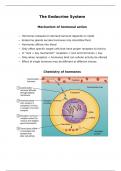
Mechanism of hormonal action
Hormones released on demand (amount depends on need)
Endocrine glands secrete hormones into interstitial fluid.
Hormones diffuse into blood
Only affect specific target cells that have proper receptors to bind to
In “lock + key mechanism” receptors = lock and hormones = key
Only when receptors + hormones bind can cellular activity be altered
Effect of single hormone may be different at different tissues
Chemistry of hormones
,Lipid-soluble hormones
Function - diffuses from blood through interstitial fluid + lipid bilayer of
plasma membrane to cell
Can also diffuse through nuclear membrane + bind to receptors deep
in nuclear machinery that will turn genes on + off.
New mRNA leaves nucleus into cytosol = direct synthesis of proteins
New proteins alter cells activity + cause physiological responses of
that cell
Water-soluble hormones
Diffuses from blood but can't cross membrane
Receptors = membrane
First massager = hormone delivering message to membrane
Second massager = relay message inside cell (cyclic AMP/cAMP
synthesized from ATP)
Alters cells function in several ways by activation of enzymes =
changes activity in cell
, Endocrine glands
Hypothalamus + pituitary
Posterior pituitary
Hormone Target tissue Effect on target Result
released tissue
Oxytocin Smooth muscle of Stimulates Expelling baby
uterus contraction + placenta
Smooth muscle of Releases milk
breast ducts during breast
feeding
ADH/ Tubules of kidneys Increases Increase BP
vasopressin permeability
Arterioles vasoconstriction
Mechanism of hormonal action
Hormones released on demand (amount depends on need)
Endocrine glands secrete hormones into interstitial fluid.
Hormones diffuse into blood
Only affect specific target cells that have proper receptors to bind to
In “lock + key mechanism” receptors = lock and hormones = key
Only when receptors + hormones bind can cellular activity be altered
Effect of single hormone may be different at different tissues
Chemistry of hormones
,Lipid-soluble hormones
Function - diffuses from blood through interstitial fluid + lipid bilayer of
plasma membrane to cell
Can also diffuse through nuclear membrane + bind to receptors deep
in nuclear machinery that will turn genes on + off.
New mRNA leaves nucleus into cytosol = direct synthesis of proteins
New proteins alter cells activity + cause physiological responses of
that cell
Water-soluble hormones
Diffuses from blood but can't cross membrane
Receptors = membrane
First massager = hormone delivering message to membrane
Second massager = relay message inside cell (cyclic AMP/cAMP
synthesized from ATP)
Alters cells function in several ways by activation of enzymes =
changes activity in cell
, Endocrine glands
Hypothalamus + pituitary
Posterior pituitary
Hormone Target tissue Effect on target Result
released tissue
Oxytocin Smooth muscle of Stimulates Expelling baby
uterus contraction + placenta
Smooth muscle of Releases milk
breast ducts during breast
feeding
ADH/ Tubules of kidneys Increases Increase BP
vasopressin permeability
Arterioles vasoconstriction


