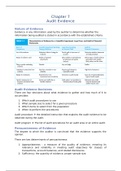
Chapter 7
Audit Evidence
Nature of Evidence
Evidence any information used by the auditor to determine whether the
information being audited is stated in accordance with the established criteria.
Audit Evidence Decisions
There are four decisions about what evidence to gather and how much of it to
accumulate:
1. Which audit procedures to use
2. What sample size to select for a given procedure
3. Which items to select from the population
4. When to perform the procedures
Audit procedure the detailed instruction that explains the audit evidence to be
obtained during the audit.
Audit program The list of audit procedures for an audit area or an entire audit.
Persuasiveness of Evidence
The degree to which the auditor is convinced that the evidence supports the
opinion.
There are two determinants of persuasiveness:
1. Appropriateness : a measure of the quality of evidence, meaning its
relevance and reliability in meeting audit objectives for classes of
transactions, account balances, and related disclosures.
2. Sufficiency: the quantity of evidence, proper sample size.
, Appropriateness
Relevance of evidence Evidence must pertain to or be relevant to the audit
objective that the auditor is testing before it can be appropriate.
Reliability of evidence refers to the degree to which evidence can be
believable or worthy of trust.
Reliability depends on the following six characteristics:
1. Independence of provider
Evidence obtained from a source outside the entity is more reliable than
that obtained from within
2. Effectiveness of clientss internal controls.
When a clientss internal controls are effective, evidence obtained is more
reliable than when they are not effective.
3. Auditorss direct knowledge
Evidence obtained directly by the auditor through physical examination,
observation, recalculation, and inspection is more reliable than
information obtained indirectly.
4. Qualifcations of individuals providing the information
Although the source of information is independent, the evidence will not
be reliable unless the individual providing it is qualifed to do so.
5. Degree of objectivity
Objective evidence is more reliable than evidence that requires
considerable judgment to determine whether it is correct.
6. Timeliness
The timeliness of audit evidence can refer either to when it is accumulated
or to the period covered by the audit.
Sufficiency
Factors determining sample size:
- Auditorss expectation of misstatement
- Effectiveness of internal control
Combined Effect
The persuasiveness of evidence can be evaluated only after considering the
combination of appropriateness and sufficiency, including the effects of the
factors infuencing appropriateness and sufficiency.
Example:
A large sample of evidence provided by an independent party is not persuasive
unless it is relevant to the audit objective being tested. A large sample of
evidence that is relevant but not objective is also not persuasive.
Audit Evidence
Nature of Evidence
Evidence any information used by the auditor to determine whether the
information being audited is stated in accordance with the established criteria.
Audit Evidence Decisions
There are four decisions about what evidence to gather and how much of it to
accumulate:
1. Which audit procedures to use
2. What sample size to select for a given procedure
3. Which items to select from the population
4. When to perform the procedures
Audit procedure the detailed instruction that explains the audit evidence to be
obtained during the audit.
Audit program The list of audit procedures for an audit area or an entire audit.
Persuasiveness of Evidence
The degree to which the auditor is convinced that the evidence supports the
opinion.
There are two determinants of persuasiveness:
1. Appropriateness : a measure of the quality of evidence, meaning its
relevance and reliability in meeting audit objectives for classes of
transactions, account balances, and related disclosures.
2. Sufficiency: the quantity of evidence, proper sample size.
, Appropriateness
Relevance of evidence Evidence must pertain to or be relevant to the audit
objective that the auditor is testing before it can be appropriate.
Reliability of evidence refers to the degree to which evidence can be
believable or worthy of trust.
Reliability depends on the following six characteristics:
1. Independence of provider
Evidence obtained from a source outside the entity is more reliable than
that obtained from within
2. Effectiveness of clientss internal controls.
When a clientss internal controls are effective, evidence obtained is more
reliable than when they are not effective.
3. Auditorss direct knowledge
Evidence obtained directly by the auditor through physical examination,
observation, recalculation, and inspection is more reliable than
information obtained indirectly.
4. Qualifcations of individuals providing the information
Although the source of information is independent, the evidence will not
be reliable unless the individual providing it is qualifed to do so.
5. Degree of objectivity
Objective evidence is more reliable than evidence that requires
considerable judgment to determine whether it is correct.
6. Timeliness
The timeliness of audit evidence can refer either to when it is accumulated
or to the period covered by the audit.
Sufficiency
Factors determining sample size:
- Auditorss expectation of misstatement
- Effectiveness of internal control
Combined Effect
The persuasiveness of evidence can be evaluated only after considering the
combination of appropriateness and sufficiency, including the effects of the
factors infuencing appropriateness and sufficiency.
Example:
A large sample of evidence provided by an independent party is not persuasive
unless it is relevant to the audit objective being tested. A large sample of
evidence that is relevant but not objective is also not persuasive.