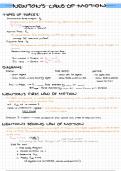
NEWTON'S LAWS OF MOTION
TYPES OF FORCES:
Gravitational force (weight: Fg
The gravitational force
Earth exerts surface
any object
the on on o r near its
Fg
=
mg-close to surface
of Earth=918m. 57
Normal force:Fr
The perpendicular force exerted by a surface on an
object in contact with it
(always 900 relative to surface)
Frictional force: Ff
The force that opposes of parallel surface with the object
the motion an
object and acts to the which is in
contant
Determined of normal force
by magnitude
->
->
co-efficient of friction (M)
In mation = Kinetic ->F5l =MicFr
max
In MsFr
-
Static ->
rest:
Ffs
=
DIAGRAMS:
FORCE: FREE BODY: VECTOR:
object draw dot (as
draw
objects
·
/ dot
·
No
object
·
· draw forces retails touching object draw forces we tail on dot ·
draw forces (rectors)
head-to-tail
ALL-LABEL F: force exerted
by
-
-
- or
Frope:
*
Force exerted
by - on ↓ is in tension)
NEWTON'S FIRST LAW OF MOTION
An state of rest uniform constant) unless it is
object will continue in a or
(moving with a
velocity
force
acted upon by a net or resultant
If Newton I
Fez = 0 ->
us understand of
Helps intia - the
tendency of an
object to resist a
change
in its state rest
- force or uniform motion
(Newton I + inertia -
more conceptual than actual calc (used to help cake the
NEWTON'S SECOND LAW OF MOTION
force, Fret, of mass, m, the accelerates the direction
When a net is applied to an
object object in
of net force. The acceleration, a, is metforce
the
directly proportional to the and
inversely proportional
to the mass
#net = m a
C ~
Yes - and we signs
force line? (it resultant)
calculating straight
-
net No ->
-
components
tips for call:
1. Free body diagram
2. Choose direction as t
3. Determine Fret
4.
Apply Fret = ma
(it objects are
connected, same acceleration)
TYPES OF FORCES:
Gravitational force (weight: Fg
The gravitational force
Earth exerts surface
any object
the on on o r near its
Fg
=
mg-close to surface
of Earth=918m. 57
Normal force:Fr
The perpendicular force exerted by a surface on an
object in contact with it
(always 900 relative to surface)
Frictional force: Ff
The force that opposes of parallel surface with the object
the motion an
object and acts to the which is in
contant
Determined of normal force
by magnitude
->
->
co-efficient of friction (M)
In mation = Kinetic ->F5l =MicFr
max
In MsFr
-
Static ->
rest:
Ffs
=
DIAGRAMS:
FORCE: FREE BODY: VECTOR:
object draw dot (as
draw
objects
·
/ dot
·
No
object
·
· draw forces retails touching object draw forces we tail on dot ·
draw forces (rectors)
head-to-tail
ALL-LABEL F: force exerted
by
-
-
- or
Frope:
*
Force exerted
by - on ↓ is in tension)
NEWTON'S FIRST LAW OF MOTION
An state of rest uniform constant) unless it is
object will continue in a or
(moving with a
velocity
force
acted upon by a net or resultant
If Newton I
Fez = 0 ->
us understand of
Helps intia - the
tendency of an
object to resist a
change
in its state rest
- force or uniform motion
(Newton I + inertia -
more conceptual than actual calc (used to help cake the
NEWTON'S SECOND LAW OF MOTION
force, Fret, of mass, m, the accelerates the direction
When a net is applied to an
object object in
of net force. The acceleration, a, is metforce
the
directly proportional to the and
inversely proportional
to the mass
#net = m a
C ~
Yes - and we signs
force line? (it resultant)
calculating straight
-
net No ->
-
components
tips for call:
1. Free body diagram
2. Choose direction as t
3. Determine Fret
4.
Apply Fret = ma
(it objects are
connected, same acceleration)