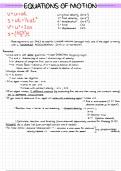
EQUATIONS OF MOTION
U =
a + at u= initial velocity Cm 5 ) .
'
' ✓ final (m
'
)
velocity 5
=
at that
.
s = +
a =
acceleration ( m 5) .
t= time ( s)
v2 =
U21-2AS S =
displacement ( m)
( E) t
"
5-
These
equations can ONLY be used for LINEAR MOTION (straight line) and if the object is moving
with a CONSTANT ACCELERATION (a--0 or a
=
constant)
Remember :
U , V , a and s vector need DIRECTION (by
quantities sign)
→
are
giving
•
a
↳ U and :
direction / sign of direction / of
motion
sign velocity
=
v
↳ 5 :
direction of straight line from start to end =
direction of displacement
↳ a "
moves faster → direction of a =
same as direction of motion
slows down → direction of a
=
opposite to direction of motion
•
always choose ref .
frame
•
t → is scalar
be
negative
→
can never
•
If an
object → moves from rest :
4=0
→ comes to rest :
v=O
with constant
→
velocity
:
u=v 9=0
moves ;
•
If an
object makes 2 different motions (eg accelerating from rest and then
moving with constant velocity)
DO 2 SEPARATE CALCULATIONS
If need to determine if will collide with make
object
•
stationary object
→
v=0
you an a
→
find s and compare (< I > than
distance available up to object)
Reaction
'
time driver is not
breaking constant
velocity
•
> → u=u =
-
. .
-
a =
0
E- reaction time
5- ? (reaction distance)
for
Calculate reaction and braking (time distance)
separately combine
stopping ( t Is )
• +
,
•
ALWAYS do a data list (with unit + sign) (convert units if needed )
For linear
]
•
motion distance displacement for distance
'
→
: - =
calculate s when asked
direction / sign
. .
no
for speed
velocity speed (scalars)
'
- = → .
. calculate v when asked
U =
a + at u= initial velocity Cm 5 ) .
'
' ✓ final (m
'
)
velocity 5
=
at that
.
s = +
a =
acceleration ( m 5) .
t= time ( s)
v2 =
U21-2AS S =
displacement ( m)
( E) t
"
5-
These
equations can ONLY be used for LINEAR MOTION (straight line) and if the object is moving
with a CONSTANT ACCELERATION (a--0 or a
=
constant)
Remember :
U , V , a and s vector need DIRECTION (by
quantities sign)
→
are
giving
•
a
↳ U and :
direction / sign of direction / of
motion
sign velocity
=
v
↳ 5 :
direction of straight line from start to end =
direction of displacement
↳ a "
moves faster → direction of a =
same as direction of motion
slows down → direction of a
=
opposite to direction of motion
•
always choose ref .
frame
•
t → is scalar
be
negative
→
can never
•
If an
object → moves from rest :
4=0
→ comes to rest :
v=O
with constant
→
velocity
:
u=v 9=0
moves ;
•
If an
object makes 2 different motions (eg accelerating from rest and then
moving with constant velocity)
DO 2 SEPARATE CALCULATIONS
If need to determine if will collide with make
object
•
stationary object
→
v=0
you an a
→
find s and compare (< I > than
distance available up to object)
Reaction
'
time driver is not
breaking constant
velocity
•
> → u=u =
-
. .
-
a =
0
E- reaction time
5- ? (reaction distance)
for
Calculate reaction and braking (time distance)
separately combine
stopping ( t Is )
• +
,
•
ALWAYS do a data list (with unit + sign) (convert units if needed )
For linear
]
•
motion distance displacement for distance
'
→
: - =
calculate s when asked
direction / sign
. .
no
for speed
velocity speed (scalars)
'
- = → .
. calculate v when asked