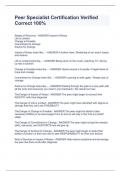
Peer Specialist Certification Verified Correct 100%
Stages of Recovery - ANSWER Impact of Illness Life is Limited Change is Possible Commitment to Change Actions for Change Impact of Illness looks like... - ANSWER A broken vase / Shattering of our world, hopes, and dreams Life is Limited looks like... - ANSWER Being stuck on the couch, watching TV / Giving up was a solution Change is Possible looks like... - ANSWER Hands around a lit candle / Fragile flame of hope and courage Commitment to Change looks like... - ANSWER Learning to walk again / Simple acts of courage Actions for Change looks like... - ANSWER Walking through the gate to a new path with all the tools and resources you need in your backpack / We rebuilt our lives The Danger of Impact of Illness - ANSWER The peer might begin to connect their IDENTITY with their diagnosis The Danger of Life is Limited - ANSWER The peer might have identified with stigma so strongly that they can't see POSSIBILITY The Danger of Change is Possible - ANSWER The peer might be afraid to take necessary RISKS (or be discouraged from it) and so will stay in the "Life is Limited" stage. The Danger of Commitment to Change - ANSWER The peer might not get the needed skills, resources, and SUPPORTS and will give up The Danger of Actions for Change - ANSWER The peer might begin to doubt their ability to function on their own and to take RESPONSIBILITY for their own actions Role of Services in Impact of Illness - ANSWER Help reduce symptoms and encourage the peer that there is life after diagnosis Role of Services in Life is Limited - ANSWER Help instill hope and sense of possibility, rebuild positive self-image, and weigh options Role of Services in Change is Possible - ANSWER Help the peer see that they are not so limited and that some risks will be necessary Role of Services in Commitment to Change - ANSWER Help the peer take their first steps by identifying their strengths and their needed supports Role of Services in Actions for Change - ANSWER Help equip the peer with skills, resources, and supports so that they build trust in their own ability and take more responsibility for their own life WRAP Key Concepts of Recovery - ANSWER Hope Personal responsibility Education Self-Advocacy Support Primary Parts of a WRAP Plan - ANSWER Wellness toolbox Daily maintenance plan Identifying triggers & an action plan Identifying early warning signs & an action plan Signs that things are breaking down & an action plan Crisis planning Post-crisis planning Principles of Self-Determination - ANSWER Freedom Authority Responsibility Whole Health & Resiliency Factors in WHAM - ANSWER Stress management Healthy eating Physical activity Restful sleep Service to others Support network Optimism (based on positive expectations) Cognitive skills (to avoid negative thinking) Spiritual beliefs & practices A sense of meaning & purpose Keys to Success in WHAM - ANSWER A person-centered goal A weekly action plan A daily/weekly personal log One-to-one Peer Support A weekly WHAM peer support group Steps in the PICBA Problem-Solving Approach - ANSWER Problem (What's keeping them from doing what they want to do?) Impact (How are they impacting the problem?)
Written for
- Institution
- Peer Specialist
- Course
- Peer Specialist
Document information
- Uploaded on
- January 18, 2024
- Number of pages
- 7
- Written in
- 2023/2024
- Type
- Exam (elaborations)
- Contains
- Questions & answers
Subjects
-
peer specialist certification verified correct 100
-
peer specialist certification stuvia
-
stages of recovery answer impact of illness lif
-
impact of illness looks like answer a broken

Document also available in package deal