
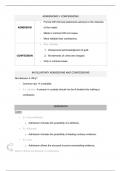
ADMISSIONS V CONFESSIONS
- Formal OR informal statements adverse to the interests
ADMISSION of the maker.
- Made in criminal OR civil cases.
- More reliable than confessions.
- Rex v Bekker
1. Unequivocal acknowledgment of guilt.
CONFESSION 2. All elements of crime are charged.
- Only in criminal cases.
INVOLUNTARY ADMISSIONS AND CONFESSIONS
Not allowed à Why?
- Common law à unreliable.
- S v January à person in custody should not be ill-treated into making a
confession.
ADMISSION
Cases
- S v Grove-Mitchell
o Admission includes the possibility of a defense.
- R v Khumalu
o Admission includes the possibility of leading contrary evidence.
- R v Xulu
o Admission allows the accused to prove exonerating evidence.
None of these are allowed in confessions
,What the cases say
- When crimes need mens rea and account from accused
o They are hardly ever confessions.
- It will only be a confession when:
o Unequivocal acknowledgement of guilt
AND
o The statement as a whole’s implication is to be a confession.
FORMAL ADMISSIONS
S220 CPA à made inside of court
- Formal admissions à automatically admissible.
- Made by state / accused.
- Presiding officer must record facts admitted.
- May be made by legal representative on behalf of accused
o Requirement à accused must confirm.
Is an admission sufficient proof or conclusive proof of fact?
- S220 CPA
o Admitting a fact placed in issue à admission is conclusive proof of fact.
- S v Sekele and S v Seesetse
o Accused can retract a formal admission by leading evidence
contradicting it.
o At the end of the case the formal admission is uncontradicted à
evidence.
, INFORMAL ADMISSION
Made outside of court
- Informal admission can be contradicted or explained away.
- Maker is allowed to put entire statement before court
o Includes incriminating and exculpatory parts.
PROBATIVE VALUE OF ADMISSIONS
Informal admissions
- Evidence can be contradicted or explained away.
- Increases the issues before the court.
Formal admissions
- Binding on the maker.
- Decreases issues before the court.
HOW ARE ADMISSIONS MADE
- Oral statements
- Written statements
- Positive conduct
o Something that was actually done.
- Negative conduct
o Silence à unable to explain an accusation.
o Jacobs v Henning à silence can be seen as an admission.
o BUT à silence can also be due to something else (not always guilt).
- Formal OR informal statements adverse to the interests
ADMISSION of the maker.
- Made in criminal OR civil cases.
- More reliable than confessions.
- Rex v Bekker
1. Unequivocal acknowledgment of guilt.
CONFESSION 2. All elements of crime are charged.
- Only in criminal cases.
INVOLUNTARY ADMISSIONS AND CONFESSIONS
Not allowed à Why?
- Common law à unreliable.
- S v January à person in custody should not be ill-treated into making a
confession.
ADMISSION
Cases
- S v Grove-Mitchell
o Admission includes the possibility of a defense.
- R v Khumalu
o Admission includes the possibility of leading contrary evidence.
- R v Xulu
o Admission allows the accused to prove exonerating evidence.
None of these are allowed in confessions
,What the cases say
- When crimes need mens rea and account from accused
o They are hardly ever confessions.
- It will only be a confession when:
o Unequivocal acknowledgement of guilt
AND
o The statement as a whole’s implication is to be a confession.
FORMAL ADMISSIONS
S220 CPA à made inside of court
- Formal admissions à automatically admissible.
- Made by state / accused.
- Presiding officer must record facts admitted.
- May be made by legal representative on behalf of accused
o Requirement à accused must confirm.
Is an admission sufficient proof or conclusive proof of fact?
- S220 CPA
o Admitting a fact placed in issue à admission is conclusive proof of fact.
- S v Sekele and S v Seesetse
o Accused can retract a formal admission by leading evidence
contradicting it.
o At the end of the case the formal admission is uncontradicted à
evidence.
, INFORMAL ADMISSION
Made outside of court
- Informal admission can be contradicted or explained away.
- Maker is allowed to put entire statement before court
o Includes incriminating and exculpatory parts.
PROBATIVE VALUE OF ADMISSIONS
Informal admissions
- Evidence can be contradicted or explained away.
- Increases the issues before the court.
Formal admissions
- Binding on the maker.
- Decreases issues before the court.
HOW ARE ADMISSIONS MADE
- Oral statements
- Written statements
- Positive conduct
o Something that was actually done.
- Negative conduct
o Silence à unable to explain an accusation.
o Jacobs v Henning à silence can be seen as an admission.
o BUT à silence can also be due to something else (not always guilt).


