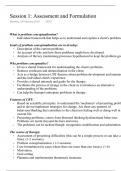
Session 1: Assessment and Formulation
Monday, 18 February 2019 09:57
What is problem conceptualisation?
- Individual framework that helps us to understand and explain a client's problems
Goals of problem conceptualisation are to develop:
- Description of the current problems.
- An account of why and how these problems might have developed.
- Analysis of the key maintaining processes hypothesised to keep the problem goi
Why problem conceptualise?
- Gives a shared framework for understanding the client's problems.
- Reduces confusion and demoralisation in the client.
- Acts as a bridge between CBT theories about problem development and mainten
and the individual client's experience.
- Provides a shared rationale and guide for the therapy.
- Facilitates the process of change in the client as it introduces an alternative
understanding of the problems.
- Can help the therapist anticipate problems in therapy.
Features of CBT:
- Based on scientific principles: to understand the 'mechanics' of presenting proble
and to devise/implement strategies for change. Are there any patterns of
behaviour/thinking that contribute to the client not feeling well or doing well in
current life.
- Presenting problems: comes from distorted thinking/dysfunctional behaviour.
Problems are learnt (beyond the here and now).
- The problems can be tackled though: recognition, modification and substitution.
The course of therapy:
- Assessment of presenting difficulties (this can be a simple process or can take a
time). (1-2 sessions)
- Problem conceptualisation. (1-3 sessions)
- Case formulation (in cases where there are more than one issues). (1-6)
- Motivation.
- Goal setting.
- Planning and implementing therapeutic strategies.
- Symptom focused strategies. (2-11)
- Schema focused strategies. (8-11)
- Relapse preventing and ending of therapy. (10-12).
,
Monday, 18 February 2019 09:57
What is problem conceptualisation?
- Individual framework that helps us to understand and explain a client's problems
Goals of problem conceptualisation are to develop:
- Description of the current problems.
- An account of why and how these problems might have developed.
- Analysis of the key maintaining processes hypothesised to keep the problem goi
Why problem conceptualise?
- Gives a shared framework for understanding the client's problems.
- Reduces confusion and demoralisation in the client.
- Acts as a bridge between CBT theories about problem development and mainten
and the individual client's experience.
- Provides a shared rationale and guide for the therapy.
- Facilitates the process of change in the client as it introduces an alternative
understanding of the problems.
- Can help the therapist anticipate problems in therapy.
Features of CBT:
- Based on scientific principles: to understand the 'mechanics' of presenting proble
and to devise/implement strategies for change. Are there any patterns of
behaviour/thinking that contribute to the client not feeling well or doing well in
current life.
- Presenting problems: comes from distorted thinking/dysfunctional behaviour.
Problems are learnt (beyond the here and now).
- The problems can be tackled though: recognition, modification and substitution.
The course of therapy:
- Assessment of presenting difficulties (this can be a simple process or can take a
time). (1-2 sessions)
- Problem conceptualisation. (1-3 sessions)
- Case formulation (in cases where there are more than one issues). (1-6)
- Motivation.
- Goal setting.
- Planning and implementing therapeutic strategies.
- Symptom focused strategies. (2-11)
- Schema focused strategies. (8-11)
- Relapse preventing and ending of therapy. (10-12).
,