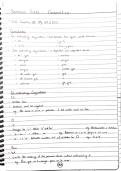
Afrikaans Notes
Verlede Tyd:
- Get no “ge” = be, her, ge, er, ver, ont, mis.
- “Word deur” changes to “is deur”.
- Helping words change…
= Kan - Kon
= Sal - Sou
= Is - Was
= Mag - Mog
= Wil - Wou
= Moet - Moes
- Remember the DAWN rule!
= Dan
As
Wanneer
Nou
*ALL changes to “TOE” (once changed leave the rest of the sentence
after the same)
- Two verbs that can be done at the same time get ONE “ge”.
- Two verbs that can’t be done at the same time get TWO “ge”.
- How to recognize past tense
= Gister
= Verlede jaar etc.
= Twee dae gelede
= Jare gelede
= Eergister het
Toekomende Tyd:
- No “ge: on verbs.
- “Is” changes to “sal wees”.
- “Het” changes to “hê’.
- If there are two verbs, move the one to the end.
- “Dis” means “dit is” therefore it changes to “Dit sal ……. wees”.
- Helping words DO NOT change.
= kan, wil, moet etc goes to the end right before the verb.
- How to recognise future tense
= Morê
= Oormorë
, = Volgende vakansie
= In die toekoms
Infinitief:
- “Om” + “te” is a verb.
- “Behoort” + “te”.
- “Hoef nie” + “te nie”.
- The long infinitief
= Om + te.
= No “ge”.
= Start with the om and the subject the the verb 1 and then the rest.
eg) Dit is ń goeie oefening om in die tuin te werk.
= Om in die tuin te werk, is goeie oefening.
= Om………….. te + verb.
- The short infinitief
= Behoort + te.
= Hoef nie + te + nie.
= Is changes to wees. ( te wees.)
eg) Leerlinge moet hul skooluniform met trots dra.
= Leerlinge behoort hul skooluniform met trots te dra.
eg) John is bang vir die hond.
= John hoef nie bang vir die hond te wees nie.
Voorsetsels:
- Prepositions.
- Different ones
= (op + wat) - waarop
= (met + wat) - waarmee
= (op + die) - daarop
= (met + dit) - daarmee
- Types of prepositions
= Aan means on
= Agter means behind
= By means by
= Met means with
= Bo means above
= Deur means by
= Na means after
= Om means about
= In means in
= Op means on
= Per means per
Verlede Tyd:
- Get no “ge” = be, her, ge, er, ver, ont, mis.
- “Word deur” changes to “is deur”.
- Helping words change…
= Kan - Kon
= Sal - Sou
= Is - Was
= Mag - Mog
= Wil - Wou
= Moet - Moes
- Remember the DAWN rule!
= Dan
As
Wanneer
Nou
*ALL changes to “TOE” (once changed leave the rest of the sentence
after the same)
- Two verbs that can be done at the same time get ONE “ge”.
- Two verbs that can’t be done at the same time get TWO “ge”.
- How to recognize past tense
= Gister
= Verlede jaar etc.
= Twee dae gelede
= Jare gelede
= Eergister het
Toekomende Tyd:
- No “ge: on verbs.
- “Is” changes to “sal wees”.
- “Het” changes to “hê’.
- If there are two verbs, move the one to the end.
- “Dis” means “dit is” therefore it changes to “Dit sal ……. wees”.
- Helping words DO NOT change.
= kan, wil, moet etc goes to the end right before the verb.
- How to recognise future tense
= Morê
= Oormorë
, = Volgende vakansie
= In die toekoms
Infinitief:
- “Om” + “te” is a verb.
- “Behoort” + “te”.
- “Hoef nie” + “te nie”.
- The long infinitief
= Om + te.
= No “ge”.
= Start with the om and the subject the the verb 1 and then the rest.
eg) Dit is ń goeie oefening om in die tuin te werk.
= Om in die tuin te werk, is goeie oefening.
= Om………….. te + verb.
- The short infinitief
= Behoort + te.
= Hoef nie + te + nie.
= Is changes to wees. ( te wees.)
eg) Leerlinge moet hul skooluniform met trots dra.
= Leerlinge behoort hul skooluniform met trots te dra.
eg) John is bang vir die hond.
= John hoef nie bang vir die hond te wees nie.
Voorsetsels:
- Prepositions.
- Different ones
= (op + wat) - waarop
= (met + wat) - waarmee
= (op + die) - daarop
= (met + dit) - daarmee
- Types of prepositions
= Aan means on
= Agter means behind
= By means by
= Met means with
= Bo means above
= Deur means by
= Na means after
= Om means about
= In means in
= Op means on
= Per means per