Assignment 3: Teaching Grammar Can Be Fun
Name: Nelize
Surname: Muller
Date: 07 November 2023
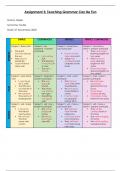
SIMPLE CONTINUOUS PERFECT PERFECT CONTINUOUS
Subject + Base verb Subject + be Subject + have/has + Subject + have/has +
(present) + present past participle been + present participle.
▪ The earth participle. ▪ They have been
PRESENT
revolves around ▪ I have not yet learning English for
the sun. ▪ I am eating taken my lunch. two years.
▪ They lead a fruit. ▪ Adam has ▪ They have not
simple life. ▪ The teacher completed two been learning
▪ I speak French is teaching in chapters of the English for two
quite well. a class. book. years.
▪ The sun is ▪ Have they been
shining. learning English for
two years?
Subject + past tense Subject + be(past) + Subject + had + past Subject + had + been +
verb present participle. participle present participle.
▪ I used to go ▪ She was ▪ We had not ▪ He had been
for a walk. going to heard this news practicing
▪ The little boy school. till yesterday. grammar for two
PAST
fed the fish in ▪ The moon ▪ He had gone hours.
the bowl. was shining home before I ▪ It had been
▪ He admired last night. came. drizzling all day.
the poetry of ▪ Everything ▪ I had not sold ▪ I had been living
Shakespeare. was going my property there for five years.
well. before 2015.
Subject + will + base Subject + will + be + Subject + will + have + Subject + will + have +
verb present participle. past participle been + present participle.
▪ I will go to ▪ She will be ▪ She will have ▪ They will be
the beach singing at tried it in the cooking food at
FUTURE
next Sunday. home. afternoon. this time.
▪ He will take ▪ He will be ▪ I will have done ▪ She will be singing
the final learning a it by tomorrow. at home.
exam next new skill. ▪ They will have ▪ We will be eating
month. built their house outside Sunday.
next year.
, 1. Simple Present Tense:
When describing an activity or occurrence that is happening right now in the specifi
ed context, the simple present tense is used in sentences.
Another name for the simple present is the present indefinite tense.
2. Simple Past Tense:
The Cambridge Dictionary defines the'simple past tense' as the form of a verb that i
s used to indicate an action that happened before the present moment and is no l
onger happening. Usually, -ed is added to create it.
3. Simple Future Tense:
When describing states or acts that start and finish in the future, the simple future te
nse is employed.
These things haven't happened yet, but they will at some point: I'll meet her at the s
hopping centre.
_________________________________________________________________________________
1. Present continuous Tense:
"The tense used to talk about actions or behavior that are in progress now or planne
d for the future" is the definition of the present continuous tense.
2. Past continuous Tense:
The past continuous tense is one that is employed to describe an ongoing activity
or occurrence that took place in the past. It employs the present participle plus the
auxiliary verb was or were.
3. Future Continuous Tense:
The verb tense that depicts an action taking place over time in the future is called
the future continuous tense. The future continuous tense is used to describe actions
that will continue throughout a predetermined amount of time in the future, such as
"I will be dancing all night."
_________________________________________________________________________________
1. Perfect Present Tense:
The present perfect tense is one that is used in the present to denote an action that
happened at a particular moment. It employs verb + ed as the auxiliary verb and
past participle for the main verb. Here are a few instances of the present perfect
tense: He's finished his homework, and I've seen this movie before.
2. Perfect Past Tense:
"The form of a verb that is used to show that an action had already finished when a
nother action happened" is how the Cambridge Dictionary defines the past perfect
tense.
Name: Nelize
Surname: Muller
Date: 07 November 2023
SIMPLE CONTINUOUS PERFECT PERFECT CONTINUOUS
Subject + Base verb Subject + be Subject + have/has + Subject + have/has +
(present) + present past participle been + present participle.
▪ The earth participle. ▪ They have been
PRESENT
revolves around ▪ I have not yet learning English for
the sun. ▪ I am eating taken my lunch. two years.
▪ They lead a fruit. ▪ Adam has ▪ They have not
simple life. ▪ The teacher completed two been learning
▪ I speak French is teaching in chapters of the English for two
quite well. a class. book. years.
▪ The sun is ▪ Have they been
shining. learning English for
two years?
Subject + past tense Subject + be(past) + Subject + had + past Subject + had + been +
verb present participle. participle present participle.
▪ I used to go ▪ She was ▪ We had not ▪ He had been
for a walk. going to heard this news practicing
▪ The little boy school. till yesterday. grammar for two
PAST
fed the fish in ▪ The moon ▪ He had gone hours.
the bowl. was shining home before I ▪ It had been
▪ He admired last night. came. drizzling all day.
the poetry of ▪ Everything ▪ I had not sold ▪ I had been living
Shakespeare. was going my property there for five years.
well. before 2015.
Subject + will + base Subject + will + be + Subject + will + have + Subject + will + have +
verb present participle. past participle been + present participle.
▪ I will go to ▪ She will be ▪ She will have ▪ They will be
the beach singing at tried it in the cooking food at
FUTURE
next Sunday. home. afternoon. this time.
▪ He will take ▪ He will be ▪ I will have done ▪ She will be singing
the final learning a it by tomorrow. at home.
exam next new skill. ▪ They will have ▪ We will be eating
month. built their house outside Sunday.
next year.
, 1. Simple Present Tense:
When describing an activity or occurrence that is happening right now in the specifi
ed context, the simple present tense is used in sentences.
Another name for the simple present is the present indefinite tense.
2. Simple Past Tense:
The Cambridge Dictionary defines the'simple past tense' as the form of a verb that i
s used to indicate an action that happened before the present moment and is no l
onger happening. Usually, -ed is added to create it.
3. Simple Future Tense:
When describing states or acts that start and finish in the future, the simple future te
nse is employed.
These things haven't happened yet, but they will at some point: I'll meet her at the s
hopping centre.
_________________________________________________________________________________
1. Present continuous Tense:
"The tense used to talk about actions or behavior that are in progress now or planne
d for the future" is the definition of the present continuous tense.
2. Past continuous Tense:
The past continuous tense is one that is employed to describe an ongoing activity
or occurrence that took place in the past. It employs the present participle plus the
auxiliary verb was or were.
3. Future Continuous Tense:
The verb tense that depicts an action taking place over time in the future is called
the future continuous tense. The future continuous tense is used to describe actions
that will continue throughout a predetermined amount of time in the future, such as
"I will be dancing all night."
_________________________________________________________________________________
1. Perfect Present Tense:
The present perfect tense is one that is used in the present to denote an action that
happened at a particular moment. It employs verb + ed as the auxiliary verb and
past participle for the main verb. Here are a few instances of the present perfect
tense: He's finished his homework, and I've seen this movie before.
2. Perfect Past Tense:
"The form of a verb that is used to show that an action had already finished when a
nother action happened" is how the Cambridge Dictionary defines the past perfect
tense.