
Homeostasis:
Homeostasis is the maintenance of constant internal environment around the cells
of the body, by self-regulating mechanisms. Homeostasis involves the constant
control of temperature, oxygen and carbon dioxide, waste, nitrogenous waste, glucose in
the blood, and pH of the blood and tissue fluid (TOWNGP).
The liver, the kidneys, and the brain (hypothalamus), the autonomic nervous system and
the endocrine system help maintain homeostasis. The liver is responsible for
metabolizing toxic substances and maintains carbohydrate metabolism. The kidneys are
responsible for regulating blood water levels, re-absorption of substance into the blood,
maintenance of salt and ion levels in the bloods, regulation of blood pH, and excretion of
nitrogenous waste like urea.
The hypothalamus of the brain is in overall charge and sends impulses to various organs
in an attempt to re-establish equilibrium, should something go wrong. The medulla
oblongata of the brain controls breathing.
An inability to maintain homeostatic may lead to death or disease, a condition known as
homeostatic imbalance.
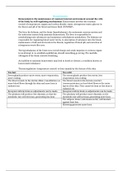
Thermoregulation (temperature control) is done mainly by the dermis of the skin:
Too hot: Too cold:
Sweat glands produce more sweat, more evaporation, The sweat glands produce less sweat, less
more cooling. evaporation, less cooling.
The blood vessels in the dermis dilate (vasodilation) so The blood vessels in the dermis constrict
more blood flows through the skin and more heat is (vasoconstriction) so less blood flows to the outer
radiated out. layers of the skin. This conserves heat as less heat is
radiated out.
Receptors inform brain so adjustments can be made. Receptors inform brain so adjustments can be made.
The pituitary will produce less thyroxin, so that the The pituitary will produce more thyroxin, so the
metabolic rate will decrease, generating less heat. metabolic rate will increase, generating more heat.
The adipose tissue (subcutaneous fat) will insulate
against heat loss.
Shivering generates more heat.


