
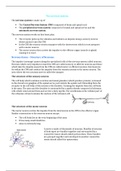
The nervous system:
The nervous system is made up of:
The Central Nervous System (CNS) composed of brain and spinal cord.
The peripheral nervous system composed of cranial and spinal nerves and the
automatic nervous system.
The nervous system works on this basic plan:
The receptor picks up the stimulus and initiates an impulse along a sensory neuron
which carries it into the CNS.
In the CNS the sensory neuron synapses with the interneuron which in turn synapses
with a motor neuron.
The motor neuron then carries the impulse to the effector organ (muscle or gland)
causing it to react.
Nervous tissue – Structure of Neurons:
The impulse (message) passes along the specialized cells of the nervous system called neurons.
Neurons which carry impulses toward the CNS are called sensory or afferent neurons and those
which take the impulse away from the CNS are called motor or efferent neurons. Interneurons
lie within the CNS and conduct the impulse from the sensory neuron to the motor neuron. The
area where the two neurons meet is called the synapse.
The structure of the sensory neuron:
The cell body which contains a nucleus and nissel granules (which produce protein), is housed
in the dorsal root ganglion of the spinal nerve, just outside the spinal cord. Extending from the
receptor to the cell body of the neuron is the dendrite. Carrying the impulse from the cell body
is the axon. The axon and the dendrite is surrounded by a myelin sheath composed of schwann
cells which wind around them and secrete a fatty myelin. The neurilemma is the cellular part of
the schwann cell and contains the nucleus of the schwann cell.
The structure of the motor neuron:
The motor neuron carries the impulse from the interneuron in the CNS to the effector organ.
Similar construction to the sensory neuron except:
The cell body lies at the very beginning of the axon
It has many small dendrites
Axon is extremely long
A nerve is made of thousands of neurons. Bundles of neurons
of both types are bundles together and surrounded by a
connective tissue sheath called perineurium. These bundles
are grouped together and enveloped in another connective
tissue sheath called the epineurium.


