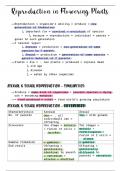
Reproductionin
Reproduction in Fl
owering Pla
Flowering nts
Plants
Reproduction = organism’s ability = produce = new
generation of themselves
↳ important for = survival + evolution of species
↳ because = reproduction = individual = passes =
genes to next generation
2 natural types:
↳ Asexual = production = new generation of same
species by 1 parent
↳ Sexual = production = generation of same species =
genetic material of 2 parents
Plants = die = new plants = produced = replace dead
↳ old age
↳ disease
↳ = eaten by other organisms
Asexual & sexual reproduction – similarities:
Produce = same kind of organisms = prevent species = dying
out = becoming extinct
= food produced = vital = feed world’s growing population
Asexual & sexual reproduction – differences:
Characteristics Asexual Sexual
No. of parents One = all Two = with gonads
individuals can =
offspring
Processes One stage = mitosis Two stages =
fusion of cells = meiosis +
quicker fertilisation =
fusion of 2 cells =
slower
Gamete formation gametes = gametes
End result Offspring = Offspring =
genetically genetically
identical to parent different to
variation = parents = variation
alleles shuffled
, = as alleles =
shuffled during:
Meiosis = when
gametes form
Fertilisation =
when alleles =
join = new
combos
Value In In
unchanging/stable changing/unstable
environments = well environment =
adapted individuals individuals with
= preserved variations = adapt
Reproduction = to new conditions
where /few mates
Reproduction rate Faster = all Slower = ½
individuals = population = males
produce offspring produce offspring
Energy input More efficient Less efficient =
energy input needed energy input needed
= produce gametes +
find/court mate
Outside agents None Pollinators (often
for pollination)
Adaptability to No Yes
environment
Possibility of Low = usually Good = genotype
evolution genotype variation variation
Asexual reproduction – advantages:
All individuals = produce offspring = energy
expenditure = produce gametes/ find mate
Simple + fast process = only involves mitosis
Useful in unchanging/stable conditions
↳ ie. if parent = well adapted to environment =
genetically identical offspring = well adapted
Favourable mutation = rapidly spread = population quickly
adapt to new environment conditions
↳ eg. insecticide/antibiotic resistance
Reproduction in Fl
owering Pla
Flowering nts
Plants
Reproduction = organism’s ability = produce = new
generation of themselves
↳ important for = survival + evolution of species
↳ because = reproduction = individual = passes =
genes to next generation
2 natural types:
↳ Asexual = production = new generation of same
species by 1 parent
↳ Sexual = production = generation of same species =
genetic material of 2 parents
Plants = die = new plants = produced = replace dead
↳ old age
↳ disease
↳ = eaten by other organisms
Asexual & sexual reproduction – similarities:
Produce = same kind of organisms = prevent species = dying
out = becoming extinct
= food produced = vital = feed world’s growing population
Asexual & sexual reproduction – differences:
Characteristics Asexual Sexual
No. of parents One = all Two = with gonads
individuals can =
offspring
Processes One stage = mitosis Two stages =
fusion of cells = meiosis +
quicker fertilisation =
fusion of 2 cells =
slower
Gamete formation gametes = gametes
End result Offspring = Offspring =
genetically genetically
identical to parent different to
variation = parents = variation
alleles shuffled
, = as alleles =
shuffled during:
Meiosis = when
gametes form
Fertilisation =
when alleles =
join = new
combos
Value In In
unchanging/stable changing/unstable
environments = well environment =
adapted individuals individuals with
= preserved variations = adapt
Reproduction = to new conditions
where /few mates
Reproduction rate Faster = all Slower = ½
individuals = population = males
produce offspring produce offspring
Energy input More efficient Less efficient =
energy input needed energy input needed
= produce gametes +
find/court mate
Outside agents None Pollinators (often
for pollination)
Adaptability to No Yes
environment
Possibility of Low = usually Good = genotype
evolution genotype variation variation
Asexual reproduction – advantages:
All individuals = produce offspring = energy
expenditure = produce gametes/ find mate
Simple + fast process = only involves mitosis
Useful in unchanging/stable conditions
↳ ie. if parent = well adapted to environment =
genetically identical offspring = well adapted
Favourable mutation = rapidly spread = population quickly
adapt to new environment conditions
↳ eg. insecticide/antibiotic resistance