
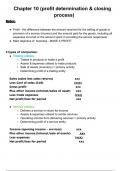
Chapter 10 (profit determination & closing
process)
Notes:
● Profit - the difference between the amount received for the selling of goods or
provision of a service (income) and the amount paid for the goods, including all
expenses incurred or the amount spent in providing the service (expenses)
● Main objective of business - MAKE A PROFIT
2 types of companies:
● Trading entities
○ Trades in products to make a profit
○ Assets & expenses utilised to trade products
○ Sale of assets (inventory) = primary activity
○ Determining profit of a trading entity:
Sales (sales less sales returns) xxx
Less Cost of sales (CoS) (xxx)
Gross profit xxx
Plus other income (interest/sales of asset) xxx
Less trade expenses (xxx)
Net profit/loss for period xxx
● Service entities:
○ Delivers a service in return for income
○ Assets & expenses utilised to render services
○ Operating income from delivering services = primary activity
○ Determining profit of a service entity:
Income (opening income - services) xxx
Plus other income (interest/sale of assets) xxx
Less expenses (xxx)
Net profit/loss for period xxx
,Important formulas & calculations:
● Gross profit = Sales - Cost of sales
GP = SP - CP
● Sales (net) = Sales (SJ & CRJ) - Sales returns (SRJ & CPJ)
● Cost of Sales (CoS) = O/B + Purchases (PJ & CPJ) - Purchases returns
(PRJ) + other costs - C/B
● Profit/Net profit = end result of all incomes - expenses
The closing process:
● At the end of the financial period the ledger accounts regarding income
statement items are merged into convenience accounts to calculate the
profit/loss for the period which has an increase or decrease in equity as a result
● During the closing-off process certain convenience accounts are created in the
ledger to make reporting easier. The different types of convenience accounts are
set out below:
Convenience Items included in the Purpose of account:
account: account:
Cost of sales (CoS) ● Opening inventory Determine CoS
● Purchases
● Closing inventory
● Other items that
affect cost of
inventory
Trade account ● Sales Determine gross profit
● CoS
Profit & loss account ● Gross profit Determine profit for the
● Income period
● Expenses
, ● CoS & sales closed-off to Trade Account
● Trade Account & all operating income & expenses closed-off to Profit and Loss
account
● Profit and Loss account, CC and Capital withdrawals closed-off to Capital
Account
CoS
Trade account
Trade Account
Cost of sales Sales
Profit and loss
Profit & Loss
Other expenses Trade account
Other income
, Chapter 11 (inventory)
Notes:
Definition of inventory:
● Assets purchased/manufactured to sell @ highest price (trading inventory/
finished goods)
● In process of production for such sale (work in progress WIP)
● Consumed in the production process of the rendering of goods/services
(consumables)
Recognition criteria:
● Expenses (I/S) when inventory is sold and inventory losses
● Asset (B/S) when inventory is unsold, unused and unfinished (recognise as a
current asset)
Measurement and valuation:
● Inventory is measured on the historical cost basis at the lowest of cost or net
realisable value
● Inventory measured at the LOWEST of historical CP or NRV
○ Inventory can become obsolete, damaged or out of fashion → causes SP
(realisable value) to decline below CP
○ Cannot realise the CP anymore
● Cost price:
○ Total costs incurred to bring inventory to their present location & condition
(ready for sale)
○ Cost price = invoice amount + costs incurred to make inventory ready for
sale
● Net realisable value (NRV):
○ Estimated selling price in the ordinary course of business less estimated
costs necessary to procure the sale
○ NRV = expected selling price - total production and selling costs
○ The "NRV" test:
1. Calculate CP
2. Calculate NRV
3. Compare!!! (choose smallest amount)
4. Journal
○ If CP<NRV leave at CP
○ If CP>NRV decrease inventory by the difference between CP and NRV (CP
- NRV) (don't want to overstate value of assets) → DR CoS & CR Inventory
, Measurement rule:
● When inventory is left over at end of the period, it is measured using the CP or
NRV of the product
○ Whichever is the lowest of CP or NRV is the VALUE of the inventory
Inventory systems:
● Periodic inventory system
● Perpetual inventory system
, Cost formulas:
● First-in-first-out (FIFO)
○ This method is based on the principle that inventory that is bought first will
be sold first
Purchase 10 items @ R10 R100
Purchase 10 items @ R15 R150
Balance 20 items R250
Sells 12 items 10 of R10 (100)
2 of R15 (30)
Balance 8 items @ R15 R120
● Weighted average
○ The average cost price (total price ÷ total quantity) can be recalculated
after each new purchase, or on a regular basis (e.g. after each month’s
purchases)
Purchase 10 items @ R10 R100
Purchase 10 items @ R15 R150
Balance 20 items @ R12.5 R250
The weighted average price =
R250 ÷ 20 = R12.5
Sells 12 items of R12.5 R150
Balance 8 items @ R12.5 R100
● Specific identification
○ This method can only be applied if the inventory is of such a nature that a
specific cost price can be linked to a specific unit over the course of time
(e.g. yachts or other expensive items)
process)
Notes:
● Profit - the difference between the amount received for the selling of goods or
provision of a service (income) and the amount paid for the goods, including all
expenses incurred or the amount spent in providing the service (expenses)
● Main objective of business - MAKE A PROFIT
2 types of companies:
● Trading entities
○ Trades in products to make a profit
○ Assets & expenses utilised to trade products
○ Sale of assets (inventory) = primary activity
○ Determining profit of a trading entity:
Sales (sales less sales returns) xxx
Less Cost of sales (CoS) (xxx)
Gross profit xxx
Plus other income (interest/sales of asset) xxx
Less trade expenses (xxx)
Net profit/loss for period xxx
● Service entities:
○ Delivers a service in return for income
○ Assets & expenses utilised to render services
○ Operating income from delivering services = primary activity
○ Determining profit of a service entity:
Income (opening income - services) xxx
Plus other income (interest/sale of assets) xxx
Less expenses (xxx)
Net profit/loss for period xxx
,Important formulas & calculations:
● Gross profit = Sales - Cost of sales
GP = SP - CP
● Sales (net) = Sales (SJ & CRJ) - Sales returns (SRJ & CPJ)
● Cost of Sales (CoS) = O/B + Purchases (PJ & CPJ) - Purchases returns
(PRJ) + other costs - C/B
● Profit/Net profit = end result of all incomes - expenses
The closing process:
● At the end of the financial period the ledger accounts regarding income
statement items are merged into convenience accounts to calculate the
profit/loss for the period which has an increase or decrease in equity as a result
● During the closing-off process certain convenience accounts are created in the
ledger to make reporting easier. The different types of convenience accounts are
set out below:
Convenience Items included in the Purpose of account:
account: account:
Cost of sales (CoS) ● Opening inventory Determine CoS
● Purchases
● Closing inventory
● Other items that
affect cost of
inventory
Trade account ● Sales Determine gross profit
● CoS
Profit & loss account ● Gross profit Determine profit for the
● Income period
● Expenses
, ● CoS & sales closed-off to Trade Account
● Trade Account & all operating income & expenses closed-off to Profit and Loss
account
● Profit and Loss account, CC and Capital withdrawals closed-off to Capital
Account
CoS
Trade account
Trade Account
Cost of sales Sales
Profit and loss
Profit & Loss
Other expenses Trade account
Other income
, Chapter 11 (inventory)
Notes:
Definition of inventory:
● Assets purchased/manufactured to sell @ highest price (trading inventory/
finished goods)
● In process of production for such sale (work in progress WIP)
● Consumed in the production process of the rendering of goods/services
(consumables)
Recognition criteria:
● Expenses (I/S) when inventory is sold and inventory losses
● Asset (B/S) when inventory is unsold, unused and unfinished (recognise as a
current asset)
Measurement and valuation:
● Inventory is measured on the historical cost basis at the lowest of cost or net
realisable value
● Inventory measured at the LOWEST of historical CP or NRV
○ Inventory can become obsolete, damaged or out of fashion → causes SP
(realisable value) to decline below CP
○ Cannot realise the CP anymore
● Cost price:
○ Total costs incurred to bring inventory to their present location & condition
(ready for sale)
○ Cost price = invoice amount + costs incurred to make inventory ready for
sale
● Net realisable value (NRV):
○ Estimated selling price in the ordinary course of business less estimated
costs necessary to procure the sale
○ NRV = expected selling price - total production and selling costs
○ The "NRV" test:
1. Calculate CP
2. Calculate NRV
3. Compare!!! (choose smallest amount)
4. Journal
○ If CP<NRV leave at CP
○ If CP>NRV decrease inventory by the difference between CP and NRV (CP
- NRV) (don't want to overstate value of assets) → DR CoS & CR Inventory
, Measurement rule:
● When inventory is left over at end of the period, it is measured using the CP or
NRV of the product
○ Whichever is the lowest of CP or NRV is the VALUE of the inventory
Inventory systems:
● Periodic inventory system
● Perpetual inventory system
, Cost formulas:
● First-in-first-out (FIFO)
○ This method is based on the principle that inventory that is bought first will
be sold first
Purchase 10 items @ R10 R100
Purchase 10 items @ R15 R150
Balance 20 items R250
Sells 12 items 10 of R10 (100)
2 of R15 (30)
Balance 8 items @ R15 R120
● Weighted average
○ The average cost price (total price ÷ total quantity) can be recalculated
after each new purchase, or on a regular basis (e.g. after each month’s
purchases)
Purchase 10 items @ R10 R100
Purchase 10 items @ R15 R150
Balance 20 items @ R12.5 R250
The weighted average price =
R250 ÷ 20 = R12.5
Sells 12 items of R12.5 R150
Balance 8 items @ R12.5 R100
● Specific identification
○ This method can only be applied if the inventory is of such a nature that a
specific cost price can be linked to a specific unit over the course of time
(e.g. yachts or other expensive items)


