
FACTORISATION
containing manyterms as
expression
> Factorisation is the process of rewriting an
an expression that is a single term. distributive lawand
of the of
> Factorising an expression is the reverse piprocess "answer" is a product
which means that the final
multiplication (i.e. F.0.1.L.),
factors and factor-brackets:
’ (...)x(...X..)
question says "multiply and simplify" we have to REMOVE
wnentne
BRACKETS; this creates many terms.
question says "factorise" we have to CREATE a product of
wien rne
BRACKETS; becoming a single term.
do usually
The type of factorising youterms in the
depends on the number of
expression!
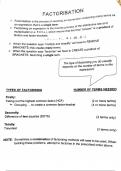
TYPES OF FACTORISING NUMBER OF TERMS NEEDED
Firstly:
Taking out the highestcommon factor (HCF) (2 or more terms)
4 Grouping... to create a common factor-bracket (4 or more terms)
Secondly:
Difference of two squares (DOTS) (2terms only)
Thirdly:
Trinomial (3 terms only)
OTE. Sometimes acombination of factoising
methods will need to be used. When
tackling these problems, attempt to factorise in the prescribed order above
, FACTORS
> Afactor is nuumber/expression without a
Something that divides into a
remainder.
Example:
Factors of 24 are 1,2,3. 4,6, 8, 12 and24.
Factors of xy are x, y and xy. 2x²y, y, 2y
Factors of 2xy are 1, 2, x,x,xy,xy, 2x, 2x*, 2xy,
Mathematics
Complete: Exercise 18.1 (page 235) Classroom
TAKING OUT THE HIGHEST COMMON FACTOR[HGH
*2 OR MORE TERMS ARE NEEDED
> Find all the factors of each term in the expression.
common factor of each term.
P Kewrite each term bringing out the
Take out the common factor.
(the remainder-bracket).
Rewrite what remains of each term in a bracket
> e.g.1 Factorise 8ak- 6bk
factorise each term.
= 2.4. a. k- 2.3. b. k
= 2k. 4a-2k. 3b bring out the common factor.
=2k(4a - 3b) divide each term by the common factor.
yousee
magical 1... now
a
> e.g.2 Factorise x - 2x + x coefficientofxis
The
youdon't. taken out.
= X.x-x. 2x +x.1 it.. now when the HCF is
becomes visible
= x(x*-2x+ 1) It
Note: There are 3 terms in the
remainder-bracket which is the same
as the original number of terms.
When the first term is
negative, or all terms
e.g.3 -a'b'c + 2ab²ç3- ab'c? are negative, we usually
= -ab'c². abc² + ab'c². 2c - ab'c²,1 take out a - sign with the
Common factor.
-ab²c² (abc' - 2c + 1)
The HCF is the lowestexponent of Notice the signs of the
terms in the
the variable that is common toALL
the terms.
remainder
bracket all change.
193 | Page
containing manyterms as
expression
> Factorisation is the process of rewriting an
an expression that is a single term. distributive lawand
of the of
> Factorising an expression is the reverse piprocess "answer" is a product
which means that the final
multiplication (i.e. F.0.1.L.),
factors and factor-brackets:
’ (...)x(...X..)
question says "multiply and simplify" we have to REMOVE
wnentne
BRACKETS; this creates many terms.
question says "factorise" we have to CREATE a product of
wien rne
BRACKETS; becoming a single term.
do usually
The type of factorising youterms in the
depends on the number of
expression!
TYPES OF FACTORISING NUMBER OF TERMS NEEDED
Firstly:
Taking out the highestcommon factor (HCF) (2 or more terms)
4 Grouping... to create a common factor-bracket (4 or more terms)
Secondly:
Difference of two squares (DOTS) (2terms only)
Thirdly:
Trinomial (3 terms only)
OTE. Sometimes acombination of factoising
methods will need to be used. When
tackling these problems, attempt to factorise in the prescribed order above
, FACTORS
> Afactor is nuumber/expression without a
Something that divides into a
remainder.
Example:
Factors of 24 are 1,2,3. 4,6, 8, 12 and24.
Factors of xy are x, y and xy. 2x²y, y, 2y
Factors of 2xy are 1, 2, x,x,xy,xy, 2x, 2x*, 2xy,
Mathematics
Complete: Exercise 18.1 (page 235) Classroom
TAKING OUT THE HIGHEST COMMON FACTOR[HGH
*2 OR MORE TERMS ARE NEEDED
> Find all the factors of each term in the expression.
common factor of each term.
P Kewrite each term bringing out the
Take out the common factor.
(the remainder-bracket).
Rewrite what remains of each term in a bracket
> e.g.1 Factorise 8ak- 6bk
factorise each term.
= 2.4. a. k- 2.3. b. k
= 2k. 4a-2k. 3b bring out the common factor.
=2k(4a - 3b) divide each term by the common factor.
yousee
magical 1... now
a
> e.g.2 Factorise x - 2x + x coefficientofxis
The
youdon't. taken out.
= X.x-x. 2x +x.1 it.. now when the HCF is
becomes visible
= x(x*-2x+ 1) It
Note: There are 3 terms in the
remainder-bracket which is the same
as the original number of terms.
When the first term is
negative, or all terms
e.g.3 -a'b'c + 2ab²ç3- ab'c? are negative, we usually
= -ab'c². abc² + ab'c². 2c - ab'c²,1 take out a - sign with the
Common factor.
-ab²c² (abc' - 2c + 1)
The HCF is the lowestexponent of Notice the signs of the
terms in the
the variable that is common toALL
the terms.
remainder
bracket all change.
193 | Page


