ALL
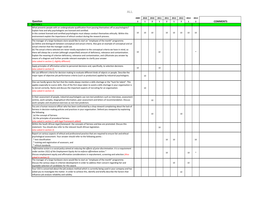
2009 2010 2010 201
Question 2 1 2 1
1 SECTION 1
What prevents people with an undergraduate qualification from passing themselves off as psychologists?
Explain how and why psychologists are licensed and certified.
In this context licensed and certified psychologists must always conduct themselves ethically. Within this 10 10 10
environment explain the importance of ethical conduct during the research process.
The manager of a large hardware store would like to start an "employee of the month" programme.
(a) Define and distinguish between conceptual and actual criteria. Also give an example of conceptual and an
actual criterion that the manager could use.
(b) The actual criteria selected are never totally equivalent to the conceptual criteria we have in mind, so
there will always be a certain (although unspecified) amount of deficiency, relevance and contamination. 10 10
Explain the meaning of criterion deficiency, relevance and contamination, and c)illustrate you answer by
means of a diagram and further provide relevant examples to clarify your answer
(also asked in section 2, slightly different)
Apply principles of affirmative action to personnel decisions and, specifically, to selection decisions.
10 10
(also asked in section 2)
We use different criteria for decision making to evaluate different kinds of objects or people. Describe the
major types of objective job performance criteria (such as production) applied by industrial psychologists. 10
One can hardly ignore the fact that the media always mention a skills shortage or the "hunt for talent". This
applies especially to scarce skills. One of the first steps taken to avoid a skills shortage in your organisation is
to recruit correctly. Name and discuss the important aspects of recruiting for an organisation. 10
(also asked in section 2)
In their assessment of people, industrial psychologists use non-test predictors such as interviews, assessment
centres, work samples, biographical information, peer assessment and letters of recommendation. Discuss 10
work samples and situational exercises as non-test predictors.
You are a human resource officer who has been confronted by a shop steward complaining about the lack of
fairness in decision-making policies and practices in your organisation. Defend you viewpoint by explaining
2009 2010 2010 201
Question 2 1 2 1
1 SECTION 1
What prevents people with an undergraduate qualification from passing themselves off as psychologists?
Explain how and why psychologists are licensed and certified.
In this context licensed and certified psychologists must always conduct themselves ethically. Within this 10 10 10
environment explain the importance of ethical conduct during the research process.
The manager of a large hardware store would like to start an "employee of the month" programme.
(a) Define and distinguish between conceptual and actual criteria. Also give an example of conceptual and an
actual criterion that the manager could use.
(b) The actual criteria selected are never totally equivalent to the conceptual criteria we have in mind, so
there will always be a certain (although unspecified) amount of deficiency, relevance and contamination. 10 10
Explain the meaning of criterion deficiency, relevance and contamination, and c)illustrate you answer by
means of a diagram and further provide relevant examples to clarify your answer
(also asked in section 2, slightly different)
Apply principles of affirmative action to personnel decisions and, specifically, to selection decisions.
10 10
(also asked in section 2)
We use different criteria for decision making to evaluate different kinds of objects or people. Describe the
major types of objective job performance criteria (such as production) applied by industrial psychologists. 10
One can hardly ignore the fact that the media always mention a skills shortage or the "hunt for talent". This
applies especially to scarce skills. One of the first steps taken to avoid a skills shortage in your organisation is
to recruit correctly. Name and discuss the important aspects of recruiting for an organisation. 10
(also asked in section 2)
In their assessment of people, industrial psychologists use non-test predictors such as interviews, assessment
centres, work samples, biographical information, peer assessment and letters of recommendation. Discuss 10
work samples and situational exercises as non-test predictors.
You are a human resource officer who has been confronted by a shop steward complaining about the lack of
fairness in decision-making policies and practices in your organisation. Defend you viewpoint by explaining