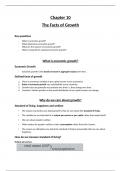
Chapter 10
The Facts of Growth
Key questions
- What is economic growth?
- What determines economic growth?
- What are the sources of economic growth?
- What is required for sustained economic growth?
What is economic growth?
Economic Growth
- Economic growth is the steady increase in aggregate output over time.
Stylised facts of growth
1. There is enormous variation in per capita income across economies.
2. Rates of economic growth vary substantially across countries.
3. Growth rates are generally not constant over time i.e. they change over time.
4. Countries’ relative position in the world distribution of per capita income can change.
Why do we care about growth?
Standard of living, happiness and welfare
• The reason economists care about growth is that we care about the standard of living.
• The variable we are interested in is output per person or per capita rather than output itself.
• We care about people’s welfare.
• What matters for people’s welfare is their consumption rather than their income.
• The reason we ultimately care about the standard of living is presumably that we care about
happiness.
How do we measure standard of living?
Output per person
, Comparing SoL across countries over time: key issues
• exchange rates can vary a lot.
• systematic differences in prices across countries.
In general, the lower a country’s output per capita, the lower the prices of food and basic services in
that country.
Solution:
• Use a common set of prices for all countries.
• Adjust real GDP numbers using these prices.
• The result is a measure of purchasing power across countries, called purchasing
power parity (PPP) numbers.
A framework for growth
Thinking about growth: A primer
Economic growth theory studies the determinants of the LR trend in GDP.
R. Solow (1958) “A Contribution to the Theory of Economic Growth”
• What determines growth?
• What is the role of capital accumulation?
• What is the role of technological progress?
The Aggregate Production Function
• The foundation for understanding growth.
• It is a specification of the relation between aggregate output and the inputs in production.
Y = aggregate output.
K = capital - the sum of all the machines, plants & office buildings in the economy.
N = labour - the number of workers in the economy.
F is a function that tells us how much output is produced for given quantities of capital and labour.
The Facts of Growth
Key questions
- What is economic growth?
- What determines economic growth?
- What are the sources of economic growth?
- What is required for sustained economic growth?
What is economic growth?
Economic Growth
- Economic growth is the steady increase in aggregate output over time.
Stylised facts of growth
1. There is enormous variation in per capita income across economies.
2. Rates of economic growth vary substantially across countries.
3. Growth rates are generally not constant over time i.e. they change over time.
4. Countries’ relative position in the world distribution of per capita income can change.
Why do we care about growth?
Standard of living, happiness and welfare
• The reason economists care about growth is that we care about the standard of living.
• The variable we are interested in is output per person or per capita rather than output itself.
• We care about people’s welfare.
• What matters for people’s welfare is their consumption rather than their income.
• The reason we ultimately care about the standard of living is presumably that we care about
happiness.
How do we measure standard of living?
Output per person
, Comparing SoL across countries over time: key issues
• exchange rates can vary a lot.
• systematic differences in prices across countries.
In general, the lower a country’s output per capita, the lower the prices of food and basic services in
that country.
Solution:
• Use a common set of prices for all countries.
• Adjust real GDP numbers using these prices.
• The result is a measure of purchasing power across countries, called purchasing
power parity (PPP) numbers.
A framework for growth
Thinking about growth: A primer
Economic growth theory studies the determinants of the LR trend in GDP.
R. Solow (1958) “A Contribution to the Theory of Economic Growth”
• What determines growth?
• What is the role of capital accumulation?
• What is the role of technological progress?
The Aggregate Production Function
• The foundation for understanding growth.
• It is a specification of the relation between aggregate output and the inputs in production.
Y = aggregate output.
K = capital - the sum of all the machines, plants & office buildings in the economy.
N = labour - the number of workers in the economy.
F is a function that tells us how much output is produced for given quantities of capital and labour.