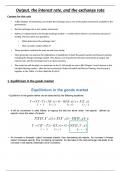
Output, the interest rate, and the exchange rate
Context for this unit
• In B&J Chapter 19 (yesterday), we treated the exchange rate as one of the policy instruments available to the
government.
• But the exchange rate is not a policy instrument.
• Rather, it is determined in the foreign exchange market—a market where there is an enormous amount of
trading. This fact raises two questions:
• What determines the exchange rate?
• How can policy makers affect it?
• These questions motivate the work we will cover today.
• More generally, we examine the implications of equilibrium in both the goods market and financial markets,
including the foreign exchange market. This allows us to characterize the joint movements of output, the
interest rate, and the exchange rate in an open economy.
• The model we will develop is an extension to the IS–LM model we saw in B&J Chapter 5 and is known as the
Mundell-Fleming model— after the two economists, Robert Mundell and Marcus Fleming, who first put it
together in the 1960s. It’s also called the IS-LM-IP.
1. Equilibrium in the goods market
,
Context for this unit
• In B&J Chapter 19 (yesterday), we treated the exchange rate as one of the policy instruments available to the
government.
• But the exchange rate is not a policy instrument.
• Rather, it is determined in the foreign exchange market—a market where there is an enormous amount of
trading. This fact raises two questions:
• What determines the exchange rate?
• How can policy makers affect it?
• These questions motivate the work we will cover today.
• More generally, we examine the implications of equilibrium in both the goods market and financial markets,
including the foreign exchange market. This allows us to characterize the joint movements of output, the
interest rate, and the exchange rate in an open economy.
• The model we will develop is an extension to the IS–LM model we saw in B&J Chapter 5 and is known as the
Mundell-Fleming model— after the two economists, Robert Mundell and Marcus Fleming, who first put it
together in the 1960s. It’s also called the IS-LM-IP.
1. Equilibrium in the goods market
,