Week 1 – Spinal cord lesions
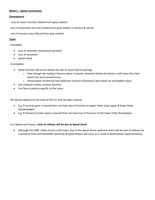
Consequence
- Loss of motor function (Ventral horn grey matter)
- Loss of autonomic function (Lateral horn grey matter in thoracic & sacral)
- Loss of sensory input (Dorsal horn grey matter)
Types
- Complete:
Loss of voluntary movement/ paralysis
Loss of sensation
Spinal shock
- Incomplete:
Some function still occurs below the site of injury (Sacral sparing)
o Even though the lumbar/ thoracic spine is injured, sensation below the lesion is still intact (Can feel
touch/ pin prick around anus)
o Preservation of external anal sphincter function (Voluntary) also shows an incomplete injury
Can maintain motor/ sensory function
Can form a pattern specific to the injury
- All injuries depend on the level of the S.C that has been injured
E.g. If cervical spine is injured then can have loss of function to upper limbs only/ upper & lower limbs
(Quadriplegia)
E.g. If thoracic/ lumbar spine is injured then can have loss of function to the lower limbs (Paraplegia)
- In a Spinal cord injury, a lack of reflexes will be due to Spinal shock
Although the LMN- reflex circuit is still intact, due to the spinal shock syndrome there will be lack of reflexes for
a period of time and thereafter spasticity & hyperreflexia will occur as a result of denervation hypersensitivity
Consequence
- Loss of motor function (Ventral horn grey matter)
- Loss of autonomic function (Lateral horn grey matter in thoracic & sacral)
- Loss of sensory input (Dorsal horn grey matter)
Types
- Complete:
Loss of voluntary movement/ paralysis
Loss of sensation
Spinal shock
- Incomplete:
Some function still occurs below the site of injury (Sacral sparing)
o Even though the lumbar/ thoracic spine is injured, sensation below the lesion is still intact (Can feel
touch/ pin prick around anus)
o Preservation of external anal sphincter function (Voluntary) also shows an incomplete injury
Can maintain motor/ sensory function
Can form a pattern specific to the injury
- All injuries depend on the level of the S.C that has been injured
E.g. If cervical spine is injured then can have loss of function to upper limbs only/ upper & lower limbs
(Quadriplegia)
E.g. If thoracic/ lumbar spine is injured then can have loss of function to the lower limbs (Paraplegia)
- In a Spinal cord injury, a lack of reflexes will be due to Spinal shock
Although the LMN- reflex circuit is still intact, due to the spinal shock syndrome there will be lack of reflexes for
a period of time and thereafter spasticity & hyperreflexia will occur as a result of denervation hypersensitivity