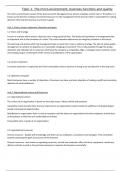
Topic 1: The micro-environment, business functions and quality
The micro-environment consists of the business itself. Management has almost complete control over it. Therefore, it is
known as the decision-making environment because it is the management of the business that is responsible for making
decisions that help the business to achieve its goals.
Unit 1: Vision, mission statement, objectives and goals
1.1 Vision and strategy
A vision is a dream which directs a business over a long period of time. The ideals and aspirations of management play
an important role in the formation of a vision. The vision therefore determines an imaginary situation in the future.
The planning and actions which top management take to meet their vision is called a strategy. The plan of action guides
management to achieve its objectives in a constantly changing environment. This is only possible through the proper
allocation and utilisation of its resources which give the company a competitive edge. A strategic Vision combines vision
and strategy to give a framework of the mission and objectives of the organisation.
1.2 mission statement
A mission statement is inspired by the Vision and explains what a business is trying to do and become in the long-term.
1.3 objectives and goals
Most businesses have a number of objectives. A business may have a primary objective of making a profit and secondary
objective of social upliftment.
Unit 2: Organisational culture and Resources
2.1 organisational culture
The culture of an organisation is based on three key issues: Values, beliefs and purposes
Values(the moral characteristics that are important to an organisation) could include the upliftment of disadvantaged
people and equal job opportunities
Belief(what an organisation feels is true) an example could be where an organisation feels that employees should dress
as they please so that they are comfortable at all times.
Purpose(the aims or goals of an organisation)
2.2 organisational resources
Human resources - people with knowledge and skills such as employees, consultants and managers. They contribute
towards achieving the goals and success of the business.
Physical resources - also known as operating resources, include raw materials, office furniture, equipment, machinery,
delivery vehicles as well as the premises necessary to operate the business successfully
, Financial resources - in the form of cash, bank overdrafts, short and medium-term loans. These financial resources are
necessary to buy stock or raw materials for the business and pay everyday expenses such as water, electricity,
stationery, wages and salaries to run the business.
Technological resources - include computers, voicemail and email or production technology. Production technology
could give the business an advantage over its competitors, so it needs to be protected by patent right or copyright to
prevent competitors from imitating it.
Unit 3: Business management, leadership and organisational structure
3.1 management and leadership
Management - the process by which an individual Guides and directs the organisation to reach its objectives. This is
done through planning, control, organising and leaders
Leadership - the way in which an individual can improve on the behaviour of others towards accomplishing the
objectives of the organisation.
3.2 organisational structure (organogram)
Organising means that management must determine what activities will be carried out and by whom. Various activities
need to be grouped under specific departments. The necessary authority and responsibility will be given to specific
people to ensure that the job is being done.
All of the above is put into a framework called the organisational structure which clearly indicates:
What work to be done and by whom
The connection between various positions and tasks
The coordination between various departments
The organisational structure needs to be reviewed from time to time so that the organisation can respond to changes
within and outside the organisation.
Unit 4: The eight business functions and their roles and importance and different types of Enterprise
4.1 the eight business functions
In any business operation, management must be effective in the business is to be successful in achieving its goals.
Management can be divided into eight business functions:
General and strategic management
Purchasing
Production and operations
Marketing
Public relations
Human resources
Administration and information
Financial and accounting
4.2 the role and importance of the eight business functions
The micro-environment consists of the business itself. Management has almost complete control over it. Therefore, it is
known as the decision-making environment because it is the management of the business that is responsible for making
decisions that help the business to achieve its goals.
Unit 1: Vision, mission statement, objectives and goals
1.1 Vision and strategy
A vision is a dream which directs a business over a long period of time. The ideals and aspirations of management play
an important role in the formation of a vision. The vision therefore determines an imaginary situation in the future.
The planning and actions which top management take to meet their vision is called a strategy. The plan of action guides
management to achieve its objectives in a constantly changing environment. This is only possible through the proper
allocation and utilisation of its resources which give the company a competitive edge. A strategic Vision combines vision
and strategy to give a framework of the mission and objectives of the organisation.
1.2 mission statement
A mission statement is inspired by the Vision and explains what a business is trying to do and become in the long-term.
1.3 objectives and goals
Most businesses have a number of objectives. A business may have a primary objective of making a profit and secondary
objective of social upliftment.
Unit 2: Organisational culture and Resources
2.1 organisational culture
The culture of an organisation is based on three key issues: Values, beliefs and purposes
Values(the moral characteristics that are important to an organisation) could include the upliftment of disadvantaged
people and equal job opportunities
Belief(what an organisation feels is true) an example could be where an organisation feels that employees should dress
as they please so that they are comfortable at all times.
Purpose(the aims or goals of an organisation)
2.2 organisational resources
Human resources - people with knowledge and skills such as employees, consultants and managers. They contribute
towards achieving the goals and success of the business.
Physical resources - also known as operating resources, include raw materials, office furniture, equipment, machinery,
delivery vehicles as well as the premises necessary to operate the business successfully
, Financial resources - in the form of cash, bank overdrafts, short and medium-term loans. These financial resources are
necessary to buy stock or raw materials for the business and pay everyday expenses such as water, electricity,
stationery, wages and salaries to run the business.
Technological resources - include computers, voicemail and email or production technology. Production technology
could give the business an advantage over its competitors, so it needs to be protected by patent right or copyright to
prevent competitors from imitating it.
Unit 3: Business management, leadership and organisational structure
3.1 management and leadership
Management - the process by which an individual Guides and directs the organisation to reach its objectives. This is
done through planning, control, organising and leaders
Leadership - the way in which an individual can improve on the behaviour of others towards accomplishing the
objectives of the organisation.
3.2 organisational structure (organogram)
Organising means that management must determine what activities will be carried out and by whom. Various activities
need to be grouped under specific departments. The necessary authority and responsibility will be given to specific
people to ensure that the job is being done.
All of the above is put into a framework called the organisational structure which clearly indicates:
What work to be done and by whom
The connection between various positions and tasks
The coordination between various departments
The organisational structure needs to be reviewed from time to time so that the organisation can respond to changes
within and outside the organisation.
Unit 4: The eight business functions and their roles and importance and different types of Enterprise
4.1 the eight business functions
In any business operation, management must be effective in the business is to be successful in achieving its goals.
Management can be divided into eight business functions:
General and strategic management
Purchasing
Production and operations
Marketing
Public relations
Human resources
Administration and information
Financial and accounting
4.2 the role and importance of the eight business functions