1
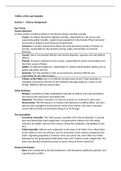
Shira Woolf
Grade 12 English 2022 Uncontrolled Portfolio Piece
4th Genre: Page to Screen
Word count: 1531
, 2
David Lynch expresses the view that a film is its ‘own
thing’ which indicates the opinion that nothing else is
allowed to affect the film by adding to it or detracting from
it. He believes that a film should stand on its own two
legs, unaffected by the previous knowledge of the novel
on which it is based. Lynch uses the word ‘discovered’ as
an instruction that the viewer of the film must start afresh
in discussing the film. If one has already read the novel,
then one must pretend that one has not. This of course, is
impossible as it is like opening a plug at the back of one’s
head and draining out all knowledge of the novel. ‘In an
ideal world’ all commentators would separate their
thoughts formed while reading the novel from what they
are about to view in the film. I disagree with Lynch as I
believe it is not possible to 'know nothing’ and to eliminate
all previous knowledge gleaned from the novel. One
cannot separate the opinions and thoughts one has
already formed in terms of the novel. Even if one tries,
the subconscious mind could easily take over and bring
the themes of the novel into the ambit of the opinions
regarding the film. I therefore believe that my experience
of the film will be affected by what I have previously read
in the novel.
I feel that going to see a film with previous knowledge of
the themes and storyline from the novel can be beneficial
as it gives a basis for comparison and allows one to
interpret the director’s presentation of the scenes and
messages of the novel. To validate my opinion, I will
assess how Frank Darabont, the director of the film
Shawshank Redemption, creates Brooks Hatlen, a
character that is there to represent Stephen King’s
original theme of institutionalization. I will also discuss the
decision Darabont has made to omit the water imagery
that is used to represent Andy’s perseverance in the
novel and rather replace it with the theme of music. In
addition, I will analyse the film, The Great Gatsby that
was directed by Baz Luhrmann and look at the changes
that no longer make Daisy Buchanan’s character
represent the empty promises, corruption and
superficiality of the American Dream as well as the
neglect of the inclusion of the theme of the failure of the
American Dream. I will assess how the directors of both
films have managed to interpret the main themes and
storylines of the subsequent novels and how my prior
knowledge from the novel has enhanced my
understanding of the film.
Darabont has created the character Brooks Hatlen as the
representation of institutionalization. He has taken the
Shira Woolf
Grade 12 English 2022 Uncontrolled Portfolio Piece
4th Genre: Page to Screen
Word count: 1531
, 2
David Lynch expresses the view that a film is its ‘own
thing’ which indicates the opinion that nothing else is
allowed to affect the film by adding to it or detracting from
it. He believes that a film should stand on its own two
legs, unaffected by the previous knowledge of the novel
on which it is based. Lynch uses the word ‘discovered’ as
an instruction that the viewer of the film must start afresh
in discussing the film. If one has already read the novel,
then one must pretend that one has not. This of course, is
impossible as it is like opening a plug at the back of one’s
head and draining out all knowledge of the novel. ‘In an
ideal world’ all commentators would separate their
thoughts formed while reading the novel from what they
are about to view in the film. I disagree with Lynch as I
believe it is not possible to 'know nothing’ and to eliminate
all previous knowledge gleaned from the novel. One
cannot separate the opinions and thoughts one has
already formed in terms of the novel. Even if one tries,
the subconscious mind could easily take over and bring
the themes of the novel into the ambit of the opinions
regarding the film. I therefore believe that my experience
of the film will be affected by what I have previously read
in the novel.
I feel that going to see a film with previous knowledge of
the themes and storyline from the novel can be beneficial
as it gives a basis for comparison and allows one to
interpret the director’s presentation of the scenes and
messages of the novel. To validate my opinion, I will
assess how Frank Darabont, the director of the film
Shawshank Redemption, creates Brooks Hatlen, a
character that is there to represent Stephen King’s
original theme of institutionalization. I will also discuss the
decision Darabont has made to omit the water imagery
that is used to represent Andy’s perseverance in the
novel and rather replace it with the theme of music. In
addition, I will analyse the film, The Great Gatsby that
was directed by Baz Luhrmann and look at the changes
that no longer make Daisy Buchanan’s character
represent the empty promises, corruption and
superficiality of the American Dream as well as the
neglect of the inclusion of the theme of the failure of the
American Dream. I will assess how the directors of both
films have managed to interpret the main themes and
storylines of the subsequent novels and how my prior
knowledge from the novel has enhanced my
understanding of the film.
Darabont has created the character Brooks Hatlen as the
representation of institutionalization. He has taken the