
DNA - THE CODE OF LIFE
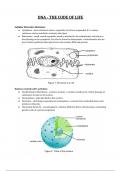
Cellular Structure Revision:
● Cytoplasm - base substance where, organelles of cell are suspended. It’s a watery
substance where metabolic reactions take place
● Ribosomes - small, round organelles mostl;y attached to the endoplasmic reticulum or
free-floating in the cytoplasm. Can also be found in chloroplasts + mitochondria but are
less. Protein synthesis takes place here and contains RNA and protein
Nucleus controls cell’s activities:
● Double Nuclear Membrane - encloses nucleus + contains small pores 2 allow passage of
substances in and out of nucleus
● Nucleoplasm - jelly-like fluid in the nucleus
● Nucleolus - dark body suspended in nucleoplasm + contains free nucleotide bases and
produces ribosome
● Chromatin Network - in nucleoplasm: contains DNA that forms chromosomes containing
genetic code of a person/organism
, Structure of Nucleic Acids:
Nucleic Acid Organic compound
Monomer Building Block
Nucleotide Monomer that forms DNA + RNA
● DNA (deoxyribonucleic acid) + RNA (ribonucleic acid) consists of nucleotides in the
human body
● Each nucleic acid is composed of the following:
DNA - deoxyribonucleic acid:
DNA ● Made of nucleotides
● Nitrogenous bases adenine, thymine, guanine + cytosine
● Carries genetic code for protein synthesis
Nuclear DNA ● Found in nucleus
Extra-nuclear DNA ● Found outside nucleus: mitochondrial + chloroplastic DNA
Double helix ● Shape of dna = 2 strands joined + twisted spirally
Hereditary ● Genetic info passed from parent to offspring
History:
● 1952 - Rosalind Franklin _ Maurice Wilkins 9assistant) researched the structure of DNA
using X-ray diffraction images
● Watson + Crick won the Nobel Prize for discovering DNA’s structure and Wilkins won an
award for his X-ray photos. Franklin died of Cancer
Location:
● Mostly in nucleus - referred to as nuclear DNA
● Small amount is found outside nucleus - referred to as extra-nuclear DNA, there are 2
types of this DNA
Cellular Structure Revision:
● Cytoplasm - base substance where, organelles of cell are suspended. It’s a watery
substance where metabolic reactions take place
● Ribosomes - small, round organelles mostl;y attached to the endoplasmic reticulum or
free-floating in the cytoplasm. Can also be found in chloroplasts + mitochondria but are
less. Protein synthesis takes place here and contains RNA and protein
Nucleus controls cell’s activities:
● Double Nuclear Membrane - encloses nucleus + contains small pores 2 allow passage of
substances in and out of nucleus
● Nucleoplasm - jelly-like fluid in the nucleus
● Nucleolus - dark body suspended in nucleoplasm + contains free nucleotide bases and
produces ribosome
● Chromatin Network - in nucleoplasm: contains DNA that forms chromosomes containing
genetic code of a person/organism
, Structure of Nucleic Acids:
Nucleic Acid Organic compound
Monomer Building Block
Nucleotide Monomer that forms DNA + RNA
● DNA (deoxyribonucleic acid) + RNA (ribonucleic acid) consists of nucleotides in the
human body
● Each nucleic acid is composed of the following:
DNA - deoxyribonucleic acid:
DNA ● Made of nucleotides
● Nitrogenous bases adenine, thymine, guanine + cytosine
● Carries genetic code for protein synthesis
Nuclear DNA ● Found in nucleus
Extra-nuclear DNA ● Found outside nucleus: mitochondrial + chloroplastic DNA
Double helix ● Shape of dna = 2 strands joined + twisted spirally
Hereditary ● Genetic info passed from parent to offspring
History:
● 1952 - Rosalind Franklin _ Maurice Wilkins 9assistant) researched the structure of DNA
using X-ray diffraction images
● Watson + Crick won the Nobel Prize for discovering DNA’s structure and Wilkins won an
award for his X-ray photos. Franklin died of Cancer
Location:
● Mostly in nucleus - referred to as nuclear DNA
● Small amount is found outside nucleus - referred to as extra-nuclear DNA, there are 2
types of this DNA


