
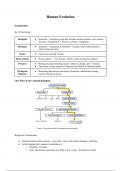
Human Evolution
Introduction
Key Terminology:
Hominids ● Hominids = biological group that includes modern humans, early human
ancestors, chimpanzees + bonobos, gorillas +orangutans
Hominins ● Hominins = sub-group of hominids + includes only modern humans +
early human ancestors
Homo ● Latin term meaning ‘human’
Homo sapiens ● Homo sapiens = ‘wise human’ which is what all humans belong to
Primates ● Biological group including lemurs, baboons, chimps, apes + humans
● They share a same number of characteristics that’ll be detailed shortly
Phylogenic ● Branching diagram/tree showing evolutionary relationships among
Diagram various biological species
Our Place in the Animal Kingdom
Biological Classification:
● Modern humans (homo sapiens - wise man) = part of the animal kingdom, Animalia
● In the kingdom the Linnaean classification is:
○ Kingdom: Animalia
○ Class: Mammalia (mammals give birth to live young + feed them on milk)
, ○ Order: Primates (with opposable thumbs on hand with 5 fingers, finger nails, not
claws, 2 eyes facing forwards, etc.)
○ Family: Hominidae (humans, chimpanzees, gorillas + orangutans)
○ Genus: Homo
○ Species: sapiens
Interpretation of a phylogenetic tree to show our place in the Animal Kingdom:
● It’s used to demonstrate evolutionary relationships of ancestral species and their descendants
● To help interpret diagram:
○ Root of phylogenetic diagram reps the ancestor, the tips of the branches, the
descendants of that ancestor (left) to move up is to move in time
○ Speciation = represented as branching of the tree, as single ancestral lineage gives rise
to 2/+ daughter lines
○ Each lineage has a part of it’s history that’s unique + parts that are shared with other
lineages
○ Each lineage has ancestors that are unique to that lineage + common ancestors that’re
shared with other lineage
● Belonging to same Family Hominidae suggests that humans, chimps, gorillas + orangutans
share a common ancestor. Studies show that humans share a common ancestor with chimps
from 6 mYrs ago
, On diagram: on left + right there’s a timeline, in million of yrs beginning at 55Myrs ago + ending in
the present
Evolution of different primates from common ancestor (A) who lived 55Myrs ago. Markers B, C, D
points to speciation events that lead eventually at marker E to the emergence of the modern human
● Marker B: Speciation event that led to evolution of gibbons as a separate species from other
primates
● Marker C: Common ancestor for Family Hominidae that include humans, chimps + bonobos,
gorillas + orangutans. These ancestors lived approx 10mil years ago
● Marker D: Common ancestor of humans + chimps which lived approx 5-6mil years ago which
indicates that of all primates, humans + chimps are most closely related
● Line from D to: Unique history of humans
● Line from C back to A: shared history of Family Hominidae and from D back to shared
history of humans + chimps
The phylogenetic tree shows us the place of the Family Hominidae in the Order Primates + larger
Kingdom Animalia
Characteristics that Humans share with African Apes:
● To help trace development of modern humans from shared ancestor of all hominids,
anatomical similarities should be considered + their differences
● Differences points to the existence of different species + similarities point to a possible
common ancestor
Key Terminology:
Arboreal ● Living primarily in trees
Opposable thumb ● Thumb that can be placed opposite fingers of the same hand
Sexual ● Distinct differences in size/appearance between the sexes of an
dimorphism animal in addition to the sexual organs themselves
Bipedalism ● Ability to walk on 2 legs
Quadrupedalism ● Use of 4 limbs for locomotion (quadrupeds)
Diurnal ● Active during the day rather than at night
Foramen magnum ● Hole in the base of skull where spinal cord passes
Cranial ● Ridge running across top of skull that served to attach large jaw
ridge muscles to head
Prognathous ● Protruding (projecting forward) upper/lower jaw
Introduction
Key Terminology:
Hominids ● Hominids = biological group that includes modern humans, early human
ancestors, chimpanzees + bonobos, gorillas +orangutans
Hominins ● Hominins = sub-group of hominids + includes only modern humans +
early human ancestors
Homo ● Latin term meaning ‘human’
Homo sapiens ● Homo sapiens = ‘wise human’ which is what all humans belong to
Primates ● Biological group including lemurs, baboons, chimps, apes + humans
● They share a same number of characteristics that’ll be detailed shortly
Phylogenic ● Branching diagram/tree showing evolutionary relationships among
Diagram various biological species
Our Place in the Animal Kingdom
Biological Classification:
● Modern humans (homo sapiens - wise man) = part of the animal kingdom, Animalia
● In the kingdom the Linnaean classification is:
○ Kingdom: Animalia
○ Class: Mammalia (mammals give birth to live young + feed them on milk)
, ○ Order: Primates (with opposable thumbs on hand with 5 fingers, finger nails, not
claws, 2 eyes facing forwards, etc.)
○ Family: Hominidae (humans, chimpanzees, gorillas + orangutans)
○ Genus: Homo
○ Species: sapiens
Interpretation of a phylogenetic tree to show our place in the Animal Kingdom:
● It’s used to demonstrate evolutionary relationships of ancestral species and their descendants
● To help interpret diagram:
○ Root of phylogenetic diagram reps the ancestor, the tips of the branches, the
descendants of that ancestor (left) to move up is to move in time
○ Speciation = represented as branching of the tree, as single ancestral lineage gives rise
to 2/+ daughter lines
○ Each lineage has a part of it’s history that’s unique + parts that are shared with other
lineages
○ Each lineage has ancestors that are unique to that lineage + common ancestors that’re
shared with other lineage
● Belonging to same Family Hominidae suggests that humans, chimps, gorillas + orangutans
share a common ancestor. Studies show that humans share a common ancestor with chimps
from 6 mYrs ago
, On diagram: on left + right there’s a timeline, in million of yrs beginning at 55Myrs ago + ending in
the present
Evolution of different primates from common ancestor (A) who lived 55Myrs ago. Markers B, C, D
points to speciation events that lead eventually at marker E to the emergence of the modern human
● Marker B: Speciation event that led to evolution of gibbons as a separate species from other
primates
● Marker C: Common ancestor for Family Hominidae that include humans, chimps + bonobos,
gorillas + orangutans. These ancestors lived approx 10mil years ago
● Marker D: Common ancestor of humans + chimps which lived approx 5-6mil years ago which
indicates that of all primates, humans + chimps are most closely related
● Line from D to: Unique history of humans
● Line from C back to A: shared history of Family Hominidae and from D back to shared
history of humans + chimps
The phylogenetic tree shows us the place of the Family Hominidae in the Order Primates + larger
Kingdom Animalia
Characteristics that Humans share with African Apes:
● To help trace development of modern humans from shared ancestor of all hominids,
anatomical similarities should be considered + their differences
● Differences points to the existence of different species + similarities point to a possible
common ancestor
Key Terminology:
Arboreal ● Living primarily in trees
Opposable thumb ● Thumb that can be placed opposite fingers of the same hand
Sexual ● Distinct differences in size/appearance between the sexes of an
dimorphism animal in addition to the sexual organs themselves
Bipedalism ● Ability to walk on 2 legs
Quadrupedalism ● Use of 4 limbs for locomotion (quadrupeds)
Diurnal ● Active during the day rather than at night
Foramen magnum ● Hole in the base of skull where spinal cord passes
Cranial ● Ridge running across top of skull that served to attach large jaw
ridge muscles to head
Prognathous ● Protruding (projecting forward) upper/lower jaw


