
1
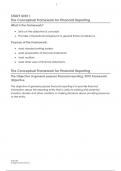
STUDY UNIT 1
The Conceptual Framework for Financial Reporting
What is the Framework?
Sets out the objectives & concepts
Provides a theoretical background or general frame of reference
Purpose of the Framework:
Assist standard setting bodies;
Assist preparation of financial statements;
Assist auditors;
Assist other users of financial statements.
The Conceptual Framework for Financial Reporting
The Objective of general purpose financial reporting: 2010 Framework
Objective
The objective of general purpose financial reporting is to provide financial
information about the reporting entity that is useful to existing and potential
investors, lenders and other creditors, in making decisions about providing resources
to the entity.
FAC1502
© Edge Business School
, 2
Study unit 1
The Conceptual Framework for Financial Reporting
Qualitative characteristics
2010 Framework
FUNDAMENTAL
Relevance - makes a difference in the decisions made by users
Faithful representation – Complete, neutral, free from error
ENHANCING
Comparability – period to period and entity to entity
Verifiability – Different, knowledgeable, independent observers reach
consensus
Timeliness - Information available to decision makers in time to influence their
decisions
Understandability - Classifying, characterising and presenting information
clearly and concisely
The Conceptual Framework for Financial Reporting
Underlying assumptions
ACCRUAL BASIS
Effects of transactions & other events are recognised when they occur
(NOT when cash flows!).
Recorded in accounting records and reported in AFS of the periods to which
they relate.
GOING CONCERN
Financial statements normally prepared on the assumption that entity is, and
will continue to operate as a going concern into the foreseeable future.
Entity not expected to liquidate in next 12 months
FAC1502
© Edge Business School
, 3
Study unit 1
The Conceptual Framework for Financial Reporting
Elements: Definition
FINANCIAL POSITION:
ASSETS = EQUITY + LIABILITIES
– This is a measure of financial POSITION at a specific date.
FINANCIAL PERFORMANCE:
INCOME – EXPENSES = PROFIT
– This is a measure of financial PERFORMANCE over a period.
FINANCIAL POSITION FINANCIAL PERFORMANCE
• Asset: • Income:
– Resource controlled by entity; – Increase in assets; or
– Resulting from past event; – Decrease in liabilities
– Expected inflow of future • Expenses:
economic benefits – Increase in liabilities; or
• Liability: – Decrease in assets
– Present obligation
– Resulting from past event
– Expected outflow of
economic resources to settle
• Equity:
– Residual interest, i.e.
– Assets – Liabilities
Asset: Future economic benefits
Liability: Settlement (FOF)
FAC1502
© Edge Business School
, 4
Study unit 1
The Conceptual Framework for Financial Reporting
Elements: Recognition Criteria
First meet the definition of one of the elements!
Then 2 recognition criteria:
1. Is PROBABLE that any FUTURE ECONOMIC BENEFITS will flow
2. COST OR VALUE that can be MEASURED with RELIABILITY
FAC1502
© Edge Business School
STUDY UNIT 1
The Conceptual Framework for Financial Reporting
What is the Framework?
Sets out the objectives & concepts
Provides a theoretical background or general frame of reference
Purpose of the Framework:
Assist standard setting bodies;
Assist preparation of financial statements;
Assist auditors;
Assist other users of financial statements.
The Conceptual Framework for Financial Reporting
The Objective of general purpose financial reporting: 2010 Framework
Objective
The objective of general purpose financial reporting is to provide financial
information about the reporting entity that is useful to existing and potential
investors, lenders and other creditors, in making decisions about providing resources
to the entity.
FAC1502
© Edge Business School
, 2
Study unit 1
The Conceptual Framework for Financial Reporting
Qualitative characteristics
2010 Framework
FUNDAMENTAL
Relevance - makes a difference in the decisions made by users
Faithful representation – Complete, neutral, free from error
ENHANCING
Comparability – period to period and entity to entity
Verifiability – Different, knowledgeable, independent observers reach
consensus
Timeliness - Information available to decision makers in time to influence their
decisions
Understandability - Classifying, characterising and presenting information
clearly and concisely
The Conceptual Framework for Financial Reporting
Underlying assumptions
ACCRUAL BASIS
Effects of transactions & other events are recognised when they occur
(NOT when cash flows!).
Recorded in accounting records and reported in AFS of the periods to which
they relate.
GOING CONCERN
Financial statements normally prepared on the assumption that entity is, and
will continue to operate as a going concern into the foreseeable future.
Entity not expected to liquidate in next 12 months
FAC1502
© Edge Business School
, 3
Study unit 1
The Conceptual Framework for Financial Reporting
Elements: Definition
FINANCIAL POSITION:
ASSETS = EQUITY + LIABILITIES
– This is a measure of financial POSITION at a specific date.
FINANCIAL PERFORMANCE:
INCOME – EXPENSES = PROFIT
– This is a measure of financial PERFORMANCE over a period.
FINANCIAL POSITION FINANCIAL PERFORMANCE
• Asset: • Income:
– Resource controlled by entity; – Increase in assets; or
– Resulting from past event; – Decrease in liabilities
– Expected inflow of future • Expenses:
economic benefits – Increase in liabilities; or
• Liability: – Decrease in assets
– Present obligation
– Resulting from past event
– Expected outflow of
economic resources to settle
• Equity:
– Residual interest, i.e.
– Assets – Liabilities
Asset: Future economic benefits
Liability: Settlement (FOF)
FAC1502
© Edge Business School
, 4
Study unit 1
The Conceptual Framework for Financial Reporting
Elements: Recognition Criteria
First meet the definition of one of the elements!
Then 2 recognition criteria:
1. Is PROBABLE that any FUTURE ECONOMIC BENEFITS will flow
2. COST OR VALUE that can be MEASURED with RELIABILITY
FAC1502
© Edge Business School


