
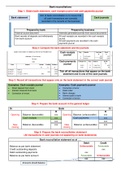
Bank reconciliations
Step 1: Obtain bank statement, cash receipts journal and cash payments journal
Aim of bank reconciliation is to insure that
Bank statement all cash transactions are correctly Cash journals
recorded in the records of the business
Prepared by bank Prepared by business
External source document Internally generated journals from source documents
Bank records all deposits and withdrawals All cash receipts are recorded in the cash receipts
from bank account journal
All cash payments are recorded in the cash
payments journal
Step 2: Compare the bank statement and the journals
Cash receipts
journal
Cash payments
journal
Tick off all transactions that appear on the bank
statement and in one of the cash journals
Step 3: Record all transactions that appear only on the bank statement in the correct cash journal
Examples: Cash receipts journal Examples: Cash payments journal
• Direct deposit from client • Correction of error
• Interest received from bank • Debit order
• Correction of errors • Bank charges
• Interest paid to bank
• Correction of errors
Step 4: Prepare the bank account in the general ledger
Dr Bank Cr
R R
Opening Balance (favourable) xxx Opening Balance (unfavourable) xxx
Cash receipts xxx Cash payments xxx
xxx xxx
New Balance (favourable) xxx New Balance (unfavourable) xxx
closing closing
Step 5: Prepare the bank reconciliation statement
(All transactions in cash journals not appearing on bank statements)
Bank reconciliation statement as at …..
Debit Credit
Balance as per bank statement Unfavourable Favourable
Credit outstanding deposits xxx
Debit outstanding payments xxx
Balance as per bank account Favourable Unfavourable
xxx xxx
Amounts should balance
Step 1: Obtain bank statement, cash receipts journal and cash payments journal
Aim of bank reconciliation is to insure that
Bank statement all cash transactions are correctly Cash journals
recorded in the records of the business
Prepared by bank Prepared by business
External source document Internally generated journals from source documents
Bank records all deposits and withdrawals All cash receipts are recorded in the cash receipts
from bank account journal
All cash payments are recorded in the cash
payments journal
Step 2: Compare the bank statement and the journals
Cash receipts
journal
Cash payments
journal
Tick off all transactions that appear on the bank
statement and in one of the cash journals
Step 3: Record all transactions that appear only on the bank statement in the correct cash journal
Examples: Cash receipts journal Examples: Cash payments journal
• Direct deposit from client • Correction of error
• Interest received from bank • Debit order
• Correction of errors • Bank charges
• Interest paid to bank
• Correction of errors
Step 4: Prepare the bank account in the general ledger
Dr Bank Cr
R R
Opening Balance (favourable) xxx Opening Balance (unfavourable) xxx
Cash receipts xxx Cash payments xxx
xxx xxx
New Balance (favourable) xxx New Balance (unfavourable) xxx
closing closing
Step 5: Prepare the bank reconciliation statement
(All transactions in cash journals not appearing on bank statements)
Bank reconciliation statement as at …..
Debit Credit
Balance as per bank statement Unfavourable Favourable
Credit outstanding deposits xxx
Debit outstanding payments xxx
Balance as per bank account Favourable Unfavourable
xxx xxx
Amounts should balance


