Study Unit 4
Definitional elements and Causation
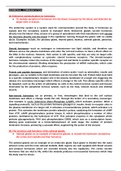
Signify concise description of requirements set out by law for liability of a specific crime. These
contain the formula that enable an ordinary person and a court to know which particular
requirements apply to why crime. Formula: Whoever does “ X ” commits a crime.
Definitional elements contain description of the kind of act that is prohibited, not strictly speaking
but particular circumscribes articles of that act. i.e. the way or certain characteristics of the person
committing the act, the nature of object, or even the specific place or time.
Difference between Formal & Materially defined crimes
Formally defined crimes:
Definitional elements proscribe a certain type of conduct, irrespective of what the result of
the conduct be. E.g. perjury, possession of drugs.
Materially defined crimes:
Definitional elements do not prescribe a specific conduct, but rather any conduct that
causes a specific condition. E.g. murder, culpable homicide, arson.
Issue of Causation
With materially defined crimes the question always of whether there is a causal link (nexus) between
X’s conduct and the prohibited result.
Determining causation
In order to find the causal link (that X’s act caused Y’s death), two requirements must be met.
1. Must be clear that X’s act is the factual cause of Y’s death
2. Must be clear that X’s was the legal cause of Y’s death.
Factual cause: one would use the condition sine qua non test whereby one finds the antecedent
(condition – act) without which the prohibited situation would not have accorded. By definition an
act is condition sine qua non for a situation if the act cannot be thought away without the situation
disappearing at the same time.
Legal cause:
Proximate-cause criterion, the act of an accused may be seen to be the legal cause of a
particular result only if the result arose directly from the accused’s conduct.
Adequate causation, an act is the legal cause of a situation if, according to human
experience, in the normal course of events, the act has the tendency to bring about that
type of situation.
Novus actus interveniens is a new intervening act, or a new intervening cause: that is to say,
an abnormal interposition or event which breaks the chain of causation.
Preferable theory
Theory of adequate causation is best to determine legal causation. Daniels case refused to accept
that in our law criminal liability is necessarily based on proximate cause.
Novus actus does not differ essentially from above. Both emphasise a distinction should be drawn
between consequences normally to be expected from the type of conduct, and consequences that
would not normally expect to flow from such conduct.
Courts approach to legal causation
Courts do not single out a specific theory of legal causation as the only correct one. A court be
guided by policy consideration to strive to reach a conclusion that would be reasonable, fair and just.
Definitional elements and Causation
Signify concise description of requirements set out by law for liability of a specific crime. These
contain the formula that enable an ordinary person and a court to know which particular
requirements apply to why crime. Formula: Whoever does “ X ” commits a crime.
Definitional elements contain description of the kind of act that is prohibited, not strictly speaking
but particular circumscribes articles of that act. i.e. the way or certain characteristics of the person
committing the act, the nature of object, or even the specific place or time.
Difference between Formal & Materially defined crimes
Formally defined crimes:
Definitional elements proscribe a certain type of conduct, irrespective of what the result of
the conduct be. E.g. perjury, possession of drugs.
Materially defined crimes:
Definitional elements do not prescribe a specific conduct, but rather any conduct that
causes a specific condition. E.g. murder, culpable homicide, arson.
Issue of Causation
With materially defined crimes the question always of whether there is a causal link (nexus) between
X’s conduct and the prohibited result.
Determining causation
In order to find the causal link (that X’s act caused Y’s death), two requirements must be met.
1. Must be clear that X’s act is the factual cause of Y’s death
2. Must be clear that X’s was the legal cause of Y’s death.
Factual cause: one would use the condition sine qua non test whereby one finds the antecedent
(condition – act) without which the prohibited situation would not have accorded. By definition an
act is condition sine qua non for a situation if the act cannot be thought away without the situation
disappearing at the same time.
Legal cause:
Proximate-cause criterion, the act of an accused may be seen to be the legal cause of a
particular result only if the result arose directly from the accused’s conduct.
Adequate causation, an act is the legal cause of a situation if, according to human
experience, in the normal course of events, the act has the tendency to bring about that
type of situation.
Novus actus interveniens is a new intervening act, or a new intervening cause: that is to say,
an abnormal interposition or event which breaks the chain of causation.
Preferable theory
Theory of adequate causation is best to determine legal causation. Daniels case refused to accept
that in our law criminal liability is necessarily based on proximate cause.
Novus actus does not differ essentially from above. Both emphasise a distinction should be drawn
between consequences normally to be expected from the type of conduct, and consequences that
would not normally expect to flow from such conduct.
Courts approach to legal causation
Courts do not single out a specific theory of legal causation as the only correct one. A court be
guided by policy consideration to strive to reach a conclusion that would be reasonable, fair and just.