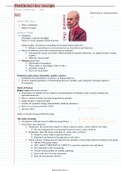
Durkheim's key concepts
Thursday, 16 March 2023 08:00
Homework or Announcements:
Part 1
Lecture Main topics:
○ Who is Durkheim
○ Study of science
Lecture notes:
• Durkheim:
Sociology as sperate discipline
Study of suicide amongst different groups
Subject matter- Social facts (something social about human behavior)
Relates to social forces (exerts pressure on us, that effects our behavior)
• There are different social facts (material and not material)
Non material- norms (can lead to different kinds of suicide) indicators- e.g. oppressiveness (strong
regime)
Material- society itself
• Method- positivism
Philosophical foundation
What counts as knowledge of the world is.
Scientific research
Has to be measurable
Positivist social science (Social law, positive science)
→ Establishes the probabilistic casual laws of human behavior
→ Involves making hypotheses of relationships between variables and testing these through empirical
investigation
Study of Science
Higher rates (only in his society)
• Protestants vs Catholics & jews (believes and integration of Catholics, more western countries are
individual believes)
• Men vs women (women are more integrated into groups)
• Single people vs married people
• In times of economic change and instability (both up and down)
• Rules of sociological method (1895)
• Suicide (1897) Use social language
Study of suicide amongst different groups
The study of suicide Always define concepts
• Description: different rates for different groups/times Always think of groups when doing Durkheim
• Social facts (non-material)
Integration- the extent (how much) to which collective norms, values, believes are share.
◊ We are integrated into social groups based on norms, values, believes.
Regulation- How the norm constraints us- norm, rules control us
◊ Guide us, know what is expected form us
◊ Regulates our behaviour through norms and values
Social currents- feelings that are shared by the members of the group/ collective feeling of the group
◊ Mood of the group (many)
◊ NOT ABOUT INDIVIDUAL (GROUP!) cannot be reduced to the individual
◊ We contribute to the social group
◊ Can be create/ produce in a public gathering
◊ Exist at the level of your interaction
◊ How do you measure/ observe
Quick Notes Page 1
Thursday, 16 March 2023 08:00
Homework or Announcements:
Part 1
Lecture Main topics:
○ Who is Durkheim
○ Study of science
Lecture notes:
• Durkheim:
Sociology as sperate discipline
Study of suicide amongst different groups
Subject matter- Social facts (something social about human behavior)
Relates to social forces (exerts pressure on us, that effects our behavior)
• There are different social facts (material and not material)
Non material- norms (can lead to different kinds of suicide) indicators- e.g. oppressiveness (strong
regime)
Material- society itself
• Method- positivism
Philosophical foundation
What counts as knowledge of the world is.
Scientific research
Has to be measurable
Positivist social science (Social law, positive science)
→ Establishes the probabilistic casual laws of human behavior
→ Involves making hypotheses of relationships between variables and testing these through empirical
investigation
Study of Science
Higher rates (only in his society)
• Protestants vs Catholics & jews (believes and integration of Catholics, more western countries are
individual believes)
• Men vs women (women are more integrated into groups)
• Single people vs married people
• In times of economic change and instability (both up and down)
• Rules of sociological method (1895)
• Suicide (1897) Use social language
Study of suicide amongst different groups
The study of suicide Always define concepts
• Description: different rates for different groups/times Always think of groups when doing Durkheim
• Social facts (non-material)
Integration- the extent (how much) to which collective norms, values, believes are share.
◊ We are integrated into social groups based on norms, values, believes.
Regulation- How the norm constraints us- norm, rules control us
◊ Guide us, know what is expected form us
◊ Regulates our behaviour through norms and values
Social currents- feelings that are shared by the members of the group/ collective feeling of the group
◊ Mood of the group (many)
◊ NOT ABOUT INDIVIDUAL (GROUP!) cannot be reduced to the individual
◊ We contribute to the social group
◊ Can be create/ produce in a public gathering
◊ Exist at the level of your interaction
◊ How do you measure/ observe
Quick Notes Page 1