Animal Cells
Cell Membrane:
1) Structure
➔ Phospholipid Bi-layer
◆ Hydrophilic Heads
◆ Hydrophobic Tails
➔ Transport Proteins
➔ Fluid Mosaic Model
N.B: Transports allow NaCl, O2, CO2, glucose and proteins to pass in an out the cells
2) Function
➔ Keeps cell contents together
➔ Control Diffusion and active transport of substances into and of the cell (semi permeable)
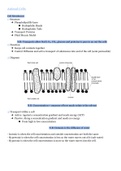
3) Diagram
N.B: Concentration = measure of how much solute is the solvent
4) Transport within a cell
➔ Active: Against a concentration gradient and needs energy (ATP)
➔ Passive: Along a concentration gradient and needs no energy
◆ From high to low concentration
N.B: Osmosis is the diffusion of water
- Isotonic is when the cell concentration and outside concentration are both the same
- Hypertonic is when the cell concentration is less so the water moves out of it (salt water)
- Hypotonic is when the cell concentration is more so the water moves into the cell.
Cell Membrane:
1) Structure
➔ Phospholipid Bi-layer
◆ Hydrophilic Heads
◆ Hydrophobic Tails
➔ Transport Proteins
➔ Fluid Mosaic Model
N.B: Transports allow NaCl, O2, CO2, glucose and proteins to pass in an out the cells
2) Function
➔ Keeps cell contents together
➔ Control Diffusion and active transport of substances into and of the cell (semi permeable)
3) Diagram
N.B: Concentration = measure of how much solute is the solvent
4) Transport within a cell
➔ Active: Against a concentration gradient and needs energy (ATP)
➔ Passive: Along a concentration gradient and needs no energy
◆ From high to low concentration
N.B: Osmosis is the diffusion of water
- Isotonic is when the cell concentration and outside concentration are both the same
- Hypertonic is when the cell concentration is less so the water moves out of it (salt water)
- Hypotonic is when the cell concentration is more so the water moves into the cell.