Plant Cells
Differences To Animals
Plastids:
- Three types of plastids can be distinguished:
➔ Chloroplast
◆ Double membrane organelles, filled with stroma and layers on membrane, lamellae, are
found in the stroma.
◆ Thickenings known as thylakoids occur on the lamella, a stack of thylakoids are known
as granum - they constrain enzymes, cytochromes and various pigments
◆ Most important chlorophyll and carotenoids - pigments absorb light for photosynthesis
and give colour
◆ Chlorophyll is more dominant - causes the green colour
➔ Chromoplast
◆ Structure is the same as chloroplasts except they do not contain chlorophyll
◆ They are responsible for the change in colour in flowers and leaves during autumn
◆ Chloroplasts lose their chlorophyll and the carotenoids change the colour
➔ Leucoplasts
◆ They are colourless plastids responsible for food storage in plant cells
◆ Reserves food can be oil droplets, proteins or starch
◆ Leucoplasts that store starch are amyloplasts
Vacuole:
- In plant cells they are large and permanent
- They are small and temporary in animal cells
➔ Function
◆ Provides shape to the plant cells
◆ Turgid is full of cell sap (turgor pressure)
◆ Flaccid has little cell sap
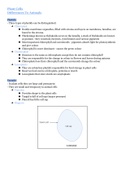
➔ Diagram
Differences To Animals
Plastids:
- Three types of plastids can be distinguished:
➔ Chloroplast
◆ Double membrane organelles, filled with stroma and layers on membrane, lamellae, are
found in the stroma.
◆ Thickenings known as thylakoids occur on the lamella, a stack of thylakoids are known
as granum - they constrain enzymes, cytochromes and various pigments
◆ Most important chlorophyll and carotenoids - pigments absorb light for photosynthesis
and give colour
◆ Chlorophyll is more dominant - causes the green colour
➔ Chromoplast
◆ Structure is the same as chloroplasts except they do not contain chlorophyll
◆ They are responsible for the change in colour in flowers and leaves during autumn
◆ Chloroplasts lose their chlorophyll and the carotenoids change the colour
➔ Leucoplasts
◆ They are colourless plastids responsible for food storage in plant cells
◆ Reserves food can be oil droplets, proteins or starch
◆ Leucoplasts that store starch are amyloplasts
Vacuole:
- In plant cells they are large and permanent
- They are small and temporary in animal cells
➔ Function
◆ Provides shape to the plant cells
◆ Turgid is full of cell sap (turgor pressure)
◆ Flaccid has little cell sap
➔ Diagram