Chapter 12
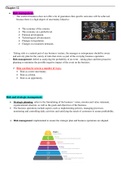
• Risk management:
- The world of business does not offer a lot of guarantees that specific outcomes will be achieved,
because there is a high degree of uncertainty linked to:
➢ The economy of the country.
➢ The economy on a global level.
➢ Political development.
➢ Technological advancements.
➢ Changes in legislation.
➢ Changes in consumers demands.
- Taking risks is a natural part of any business venture, the manager or entrepreneur should be aware
and actively plan for the variety of risks that exists as part of the everyday business operation.
- Risk management: defied as analyzing the probability of an event – taking place and then proactive
planning to minimize the possible negative impact of the event on the business.
➢ Risk can thus be seen in a number of ways:
• Risk as a mere uncertainty.
• Risk as a threat.
• Risk as an opportunity.
Risk and strategic management:
• Strategic planning: refers to the formulating of the business’ vision, mission and value statement,
organizational structure, as well as the goals and objectives of the business.
• The business operations include aspects such as implementing policies, managing processes,
monitoring and controlling daily activities and satisfying the needs of customers to ensure profitability.
➢ Risk management: implemented to ensure the strategic plan and business operations are aligned.
, The interrelationship between business strategy, risk management and business operations:
Strategy:
Vision, mission, value statement, goals &
objectives
Risk management:
Alignment between business strategy & business
operations.
Business operations:
Implementing policies, managing processes,
monitoring & controlling daily activities.
Risk management in practice:
- The way a business views risk is influenced by a business risk profile and risk culture.
• Risk profile:
➢ The risk profile of the business refers to the degree that a business is willing to accept
risks in pursuit of creating value or to achieve the businesses goals.
➢ The risk profile is directly related to the strategy of the business.
➢ Any business should try to achieve a balance between business growth, possible
returns and risks.
• Risk culture:
➢ Business culture can be described as shared attitudes and practices in the business.
➢ Risk culture of the business refers to the collective attitude in the business towards
accepting risks.
➢ Risk culture is the result of the businesses practices such as rewards for risk-taking or
risk – avoiding behaviour.
• Risk management:
- The world of business does not offer a lot of guarantees that specific outcomes will be achieved,
because there is a high degree of uncertainty linked to:
➢ The economy of the country.
➢ The economy on a global level.
➢ Political development.
➢ Technological advancements.
➢ Changes in legislation.
➢ Changes in consumers demands.
- Taking risks is a natural part of any business venture, the manager or entrepreneur should be aware
and actively plan for the variety of risks that exists as part of the everyday business operation.
- Risk management: defied as analyzing the probability of an event – taking place and then proactive
planning to minimize the possible negative impact of the event on the business.
➢ Risk can thus be seen in a number of ways:
• Risk as a mere uncertainty.
• Risk as a threat.
• Risk as an opportunity.
Risk and strategic management:
• Strategic planning: refers to the formulating of the business’ vision, mission and value statement,
organizational structure, as well as the goals and objectives of the business.
• The business operations include aspects such as implementing policies, managing processes,
monitoring and controlling daily activities and satisfying the needs of customers to ensure profitability.
➢ Risk management: implemented to ensure the strategic plan and business operations are aligned.
, The interrelationship between business strategy, risk management and business operations:
Strategy:
Vision, mission, value statement, goals &
objectives
Risk management:
Alignment between business strategy & business
operations.
Business operations:
Implementing policies, managing processes,
monitoring & controlling daily activities.
Risk management in practice:
- The way a business views risk is influenced by a business risk profile and risk culture.
• Risk profile:
➢ The risk profile of the business refers to the degree that a business is willing to accept
risks in pursuit of creating value or to achieve the businesses goals.
➢ The risk profile is directly related to the strategy of the business.
➢ Any business should try to achieve a balance between business growth, possible
returns and risks.
• Risk culture:
➢ Business culture can be described as shared attitudes and practices in the business.
➢ Risk culture of the business refers to the collective attitude in the business towards
accepting risks.
➢ Risk culture is the result of the businesses practices such as rewards for risk-taking or
risk – avoiding behaviour.