AUE2602 ASSIGNMENT 1 PREP SEMESTER 2
Exam (elaborations)
AUE2602 ASSIGNMENT 1 PREP 2024 SEMESTER 2
Rating
Sold
1
Pages
82
Grade
A+
Uploaded on
08-02-2023
Written in
2022/2023
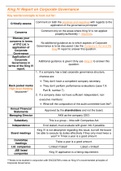
AUE2602 ASSIGNMENT 1 PREP 2024 SEMESTER 2 1.1 Background of Corporate Governance in South Africa INTRODUCTION The Industrial Revolution began in Britain in the 18th century from 1760 to 1840 and from there spread to other parts of the world ( Industrial Revolution businesses grew from entities owned and managed by the same person into large organisations in which the owners (shareholders) and management (executive directors) were separate parties. Currently in most countries, the shareholders appoint the directors in a company to manage their investment in the company. This is also known as principal-agent theory, where the shareholders are the principals and the directors are the agents. Accordingly, it became necessary for the development of guidelines for how the directors and managers of a company should act to protect and manage the interest of the shareholders and other stakeholders. This led to the concept of corporate governance. Statements like the following have been made regarding corporate governance: “The King Commission describes Corporate Governance simply as ‘the system by which companies are directed and controlled’.” (King 1994) In this topic you will learn about corporate governance in South Africa, with specific reference to the King IV Report on Governance. King I, II and III had their foundation in ethical and effective leadership. King IV is also based on these foundations, but was drafted to make it more easily applicable to all organisations to include public and private, large and small, for-profit and non-profit organisations (King IV 2016:6). The fourth King Report on Corporate Governance in South Africa (King IV), issued by the Institute of Directors in Southern Africa, is South Africa’s definitive corporate governance code. King IV envisions good governance as the achievement of four outcomes: ethical culture, good performance, effective control and legitimacy. These outcomes may be achieved by adherence to King IV’s 16 governance principles and their accompanying recommended practices. While compliance with King IV is voluntary, the listing requirements compel issuers to implement certain of its recommendations, with the balance to be adopted in accordance with King IV’s “apply and explain” disclosure regime. You can find the King IV Code at this link: What is agency theory? Agency theory is used to understand the relationships between agents and principals. This leads to the principal-agent problem. The principal-agent problem occurs when the interests of a principal and agent come into conflict. Companies should seek to minimise these situations through solid corporate policy. The different interests of principals and agents may become a source of conflict, as some agents may not perfectly act in the principal's best interests. The resulting miscommunication and disagreement may result in various problems and discord within companies. Incompatible desires may drive a wedge between each stakeholder and cause inefficiencies and financial losses. This leads to the principal-agent problem. STUDY MATERIAL · The King IV Report (2016:3–7, 20–38) [What does (2016:3-7) mean? – It means go to King IV, pages 3 to 7]. · Richard, Roets, Adams, West (2021:4/2–4/16) [What does (2021:4/2) mean? – It means go to chapter 4 of the prescribed textbook, page 2] Note: Whenever this icon is displayed it means that you will have to go to study references in the prescribed study material. This will include either one or both prescribed textbooks Auditing notes for South African students and/or the SAICA student handbook (or the electronic version). You then need to read the specific pages or paragraphs as indicated and prepare your own summaries/study notes from this for further studying and revision at a later stage. Part 2 of the King IV Report (2016:20–38) contains the fundamental concepts and philosophy on which King IV is based, the distinguishing features of King IV and how the various developments in corporate governance, locally and internationally, since King III came into effect in 2009, have influenced the principles and practices in the Code. The philosophy of King IV is focused on • companies’ role and responsibility in society • corporate citizenship • sustainable development • stakeholder inclusivity and responsiveness • integrated reporting and integrated thinking This philosophy is centred on three paradigm shifts in corporate governance: · from financial capitalism to inclusive capitalism · from short termism to long-term sustainability · from silo reporting to integrated reporting You will notice that King IV brings a more refined focus in terms of the obligation of the organisation (to be accountable and transparent) as well as the accountability of the company as a broader stakeholder within the broader society. King IV deliberately talks about ubuntu, an African concept that implies “I am because you are”. Therefore there should be common purpose to all human endeavours (including corporate endeavours), based on service to humanity. To illustrate the philosophy of ubuntu: A successful businessman in Polokwane, South Africa, showed ubuntu by buying 100 sewing machines at an auction, which he then made available to men and women in the community who were interested in starting tailoring businesses but did not have the necessary capital. He honoured their dignity by making a simple verbal agreement that they would pay him for the machines once there were sufficient profits to begin interest-free payments. This is typical of ubuntu consciousness and still occurs widely both in rural South Africa and among African communities in urban areas. It is now time for your first activity to reflect on what you have learnt thus far. Try do this activity on your own without consulting other learning material to assess whether you have mastered this part of the lesson. On submission of your answer, the solution will be released to you to reflect on. ACTIVITY 1 Define good corporate governance and briefly explain in your own words why it is important to society that companies operate within a framework of good corporate governance. How did you find this activity? If your answer (which you provided from your own understanding) did indeed capture the facts mentioned above, then you are ready to proceed to the next section of this lesson. If, however, you notice that your answer did not fully capture the information provided in the guidelines, then you need to go back to the discussion of the term “corporate governance”. ACTIVITY 2 The basis of any code on corporate governance can be legislated (a set of rules), or voluntary (principles and practices), or a combination of both. The King IV Report identifies these two bases as “comply or else” or “comply or explain” and describes a further variation of the latter, i.e. “apply and explain” (Richard et al 2021:4/4). Explain in your own words what the concept “apply and explain” means. Do you think that this allows directors to avoid adhering to principles of good corporate governance? ACTIVITY 3 Discuss in your own words what you understand by stakeholder inclusivity. ACTIVITY 4 Describe what it means for an organisation to be an integral part of society. Now that you are familiar with how you should study, remember to always compare your answers with those provided in the feedback after you attempted them on your own first. SUMMARY In this lesson you learnt what good corporate governance in South Africa means, with specific reference to the King IV Report and Code on Governance. After having worked through the lesson and the references to the prescribed study material, determine if you are able to · describe the background of corporate governance in South Africa Fantastic! If you studied all the content presented in this lesson and completed the activities dealing with this topic, you just finished studying lesson 1.1 and should continue to lesson 1.2. 1.2 Statutory Matters INTRODUCTION “There is always a link between good governance and compliance with law. Good governance is not something that exists separately from the law and it is entirely inappropriate to unhinge governance from the law.” (King [sa]) In the previous lesson you learnt what good corporate governance in South Africa means, with specific reference to the King IV Report and Code on Governance. The Companies Act 71 of 2008 provides that a company’s board of directors must manage the business and affairs of that company. The board of directors of a company has the authority to exercise all of the powers and perform any of the functions of the company (except to the extent that the Act or the company’s Memorandum of Incorporation (MOI) provides otherwise). The Act and MOI can restrict the powers of the board of directors and, for instance, ensure that · for certain transactions, the directors cannot act alone · certain matters are referred to the shareholders of a company for consideration and approval Some of you may already have studied sections of the Companies Act 71 of 2008. As directors play a very important role in corporate governance, we want to ensure that you have sufficient background knowledge of the sections of this Act specifically dealing with directors. Here is the link to the Companies Act: What is a director? A director is a member of the body of people that manages a company. Together, the directors of a company are called the board of directors (Companies Act 71 of 2008). Once you have acquired this knowledge, you will study the King IV Report in lesson 1.3. 1.2.1 The board, directors and prescribed officers, election, ineligibility and disqualification, and vacancies The board, directors and prescribed officers (sec 66) – also refer to Regulation 38 This section deals with the board, directors and prescribed officers. In terms of the definition in section 1 of the Companies Act, a director is a member of the board of a company or an alternate director (person appointed to act on behalf of a director). The minimum number of directors required for different types of companies is indicated in table 1.2.1 below. Table 1.2.1: Requirements for number of directors as per Companies Act In FAC1501 you learnt about the different categories of companies. Refer to the diagram below to familiarise yourself with the different companies: Type of company Minimum number of directors Private company (Proprietary Limited or (Pty) Ltd) 1 Limited Incorporated company (Incorporated or Inc) 1 Public company (Limited or Ltd) 3 State-owned company (SOC Limited or SOC Ltd) 3 (refer to sec 9(1)) Not-for-profit company (NPC) 3 Profit companies [sec 8(2)] - State-owned companies - Public companies - Private companies - Personal liability companies CHARACTERISTICS State-owned companies [sec 1] - A state-owned enterprise - A company owned by a municipality Public companies - Unrestricted transferability of shares - Offers to public permissible - Minimum of one incorporator - Minimum of three directors (for governance purposes) Private companies - Fewer disclosure and transparency requirements than those for public companies - Transferability of securities restricted - Minimum of one incorporator - Minimum of one director Personal liability companies [sec 8(2)(c)] - Meets criteria of private company - MOI states that it is a personal liability company DIAGRAM 1.2.1: Categories of companies The MOI of a company may specify a higher number of directors. The MOI of a profit company (other than a state-owned company) requires the shareholders to elect at least 50% of the directors (including alternates). Any other person stipulated in the MOI may appoint the remaining directors. What is a Memorandum of Incorporation? The founding document of a company under the Companies Act is the Memorandum of Incorporation (MOI) of a company (Companies Act 71 of 2008). STUDY • Section 66 of the Companies Act – as well as Regulation 38 • Richard et al (2021:3/34-3/35) Election and removal of directors (sec 67–71) Diagram 1.2.2 below illustrates the election and removal of directors. Persons who are ineligible or disqualified from being directors may not be appointed. Note that the shareholders may remove a director [sec 71(1)] and that certain steps must then be taken [sec 72(a) & (b)]. In some circumstances, the board of directors may remove a director [sec 71(3)–(5)], for example if the director is found to be negligent. STUDY · Study sections 67 to 71 of the Companies Act · Richard et al (2021:3/35-3/37) DIAGRAM 1.2.2: Election and removal of directors ACTIVITY 5 1. List the persons that are ineligible from being appointed as a director in terms of the Companies Act. 2. List the persons that are disqualified from being appointed as a director in terms of the Companies Act. ACTIVITY 6 You are a chartered accountant (SA) and an expert on the Companies Act. Document Exchange Ltd (Docex) specialises in the distribution of local and international mail and parcels. Docex has branches countrywide to spread its service delivery footprint and its customers range from individuals to large companies. Docex holds a 70% interest in Carrier and Freight Company Ltd (CFC). An extract of the minutes of the meeting of the board of directors of Docex is provided below: Present: Mr Fana Freight, chairman, independent non-executive director Mr Clement Courier, non-executive director Mr Tim Transport, sales and marketing director Mr Lesley Logistics, managing director Ms Patricia Post, financial director Mr Mannie Mail, company secretary Apologies: Mr Rocky Road, executive director Matters for discussion: Dismissal of a director Fana Freight presented to the board that allegations recently arose against Rocky Road regarding his involvement in a fraudulent scheme where R3 million was stolen from Docex. Fana Freight explained that Rocky Road has not been found guilty yet; however, it is in the best interest of the company to dismiss Rocky Road immediately. The board agreed and approved the decision to remove Rocky Road as director of Docex. Appointment of director The board resolved that Rocky Road will be replaced as director. Clement Courier presented a list of recommended candidates to be considered for the position to replace Rocky Road as director. The following candidates appeared on the list: · Mr Air Mail, Patricia Post’s 17-year-old son who obtains high marks for Accounting · Container Incorporated, a personal liability company · Ms Delores Stamp, chartered accountant (SA), the court declared her as a rehabilitated insolvent · Mr Louis Letter was convicted and imprisoned due to his involvement in fraudulent activities at his previous company The board resolved that the appointment of the new director from the list of recommended candidates will be made at the next board meeting. REQUIRED: Explain to the board which of the candidates listed under “Appointment of director” will be permissible and which of the candidates will not be permissible in terms of the requirements of the Companies Act to be appointed as the new director of Docex. Discuss whether it was legal in terms of the Companies Act for the board to dismiss the director. 1.2.2 Board committees, meetings and directors acting other than at meetings This lesson deals with board committees and board/directors’ meetings. What is a board committee? A board committee is a committee formed to perform specific functions of the board (Companies Act 71 of 2008). Board committees (sec 72) – also refer to Regulation 43(1) Section 72 of the Companies Act provides that, except when the MOI provides otherwise, the board of directors may appoint any number of committees and may delegate any of the authority of the board to a committee. The board is responsible for performing its duties properly, and a director or the board cannot use the appointment of a committee as a shield against their own responsibility [sec 72(3)]. The audit committee is one of the possible committees that can be formed, and it has an important function to fulfil. In terms of section 94 of the Companies Act, it is compulsory for a public company and a state-owned company to have an audit committee. The King IV Report recommends that all other companies that issue audited financial statements consider appointing an audit committee and define its composition, purpose and duties in the MOI. History of the social and ethics committee During the public hearings on the Companies Bill conducted by the Portfolio Committee on Trade and Industry in 2007, a proposal was made to include a requirement in the new Act to oblige certain companies to appoint a member of a trade union as a board member (director). The Portfolio Committee rejected this proposal but presented a compromise. It was argued that there is a definite need in the South African context to encourage large companies (especially those companies that have a significant impact on the public interest) to not only act responsibly, but also to be seen to be doing so and to account from the public interest perspective for their decision-making processes and the results thereof. In essence, it was argued that these companies should be obliged to develop a social conscience and behave like responsible corporate citizens. As such, the Companies Act now provides the Minister of Trade and Industry with the authority to require certain companies to have a social and ethics committee, having regard to the impact such companies have on the public interest. However, regardless of the requirement to appoint a social and ethics committee, the directors and prescribed officers of all companies are bound to act in accordance with an acceptable standard of conduct. In terms of section 72 of the Act (read with Regulation 43 of the Companies Act), the following companies should have appointed a social and ethics committee within one year after the Act became effective (i.e. by 30 April 2012): • every state-owned company • every listed public company • any other company that has, in any two of the previous five years, had a public interest score of at least 500 points In terms of Regulation 43, a social and ethics committee has to monitor the company’s activities with regard to matters relating to social and economic development, including the company’s standing in terms of the goals and purposes of • the 10 principles set out in the United Nations Global Company Principles and the Organisation for Economic Co-operation and Development (OECD) recommendations regarding corruption (refer to the OECD website for further details ()) • the Employment Equity Act 55 of 1998 • the Broad-based Black Economic Empowerment Act 53 of 2003 • good corporate citizenship, including the company’s o promotion of equality, prevention of unfair discrimination and measures to address corruption o contribution to development of the communities in which its activities are predominantly conducted or within which its products or services are predominantly marketed o record of sponsorship, donations and charitable giving • corporate citizenship (will be discussed in more detail in learning unit 1.3) • the environment, health and public safety, including the impact of the company’s activities and of its products or services • consumer relationships, including the company’s policies and record relating to advertising • public relations and compliance with consumer protection laws • labour and employment matters STUDY · Study section 72 of the Companies Act as well as Regulation 43(1) · Richard et al (2021:3/37) Board meetings/directors’ meetings (sec 73) Section 73 of the Companies Act as discussed in your textbook by Richard et al (2021:3/37- 3/38) deals with the requirements of board meetings. The company’s board may determine the form of and time for giving notice (of a meeting) as long as these comply with any requirements included in the company’s MOI or rules. Except to the extent that the company’s MOI provides otherwise, section 73(5) (a–d) provides certain requirements that have to be met at board meetings, including the voting rights of each director. Section 73 also provides for the keeping of the minutes of meetings. Why do you think minutes to a meeting are so important? Directors should keep a written record of how and why they voted for matters at board meetings. This requirement flows from their duties and possible liabilities in terms of sections 76 and 77, respectively. STUDY • section 73 of the Companies Act. • Richard et al (2021:3/37-3/38)
Show more
Read less
Institution
University Of South Africa (Unisa)
Content preview
Written for
Document information
- Uploaded on
- February 8, 2023
- Number of pages
- 82
- Written in
- 2022/2023
- Type
- Exam (elaborations)
- Contains
- Questions & answers
Subjects
- aue2602
-
aue2602 assignment 1 prep 2022 semester 2 2023
-
aue2602 assignment 1 prep 2023 semester 2
-
aue2602 assignment 1 prep 2023 semester 2
-
aue2602 corporate governance in accountancy
R46,08
Get access to the full document:
100% satisfaction guarantee
Immediately available after payment
Both online and in PDF
No strings attached