Chapter 7 –
Partnerships:
financial
statements
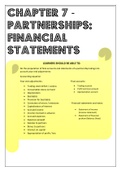
LEARNERS SHOULD BE ABLE TO:
Do the preparation of final accounts and statements of a partnership taking into
account year-end adjustments:
Accounting equation
Year-end adjustments: Final accounts:
• Trading stock deficit / surplus • Trading account
• Consumable stores on hand • Profit and Loss account
• Depreciation • Appropriation account
• Bad debts
• Provision for bad debts
• Correction of errors / omissions Financial statements and notes:
• Capitalisation of Interest
• Accrued income • Statement of income
• Income received in advance (Income statement)
• Accrued expenses • Statement of financial
position (Balance Sheet)
• Expenses prepaid
• Salaries to partners
• Bonus to partners
• Interest on capital
• Appropriation of profit / loss
, The purpose of financial statements
Financial statements must provide information about the financial position, financial
performance, and cash flow of a business to a wide variety of users. The financial
statements also show if the resources of the business were managed effectively.
Qualitive properties of financial statements
Intelligibility: information should be intelligible to users
Applicability: users should be able to use information for decision-making purposes
Reliability: information is reliable if it is free from mistakes, unbiased, prudent &
complete
Comparability: the business should be able to compare statements from one year to
the next. Similar entries should be able to compare statements in order to evaluate
their performance
Users of financial information
Financial statements are used by various parties for different reasons:
User Reason
Partners To see how the business has fared and what the status
of the business is.
Credit providers and the bank To see whether the business will be able to repay a
loan and whether it is creditworthy to grant overdraft
facilities.
SARS Tax purposes.
Auditor To make sure that sound and Generally Accepted
Accounting Practices are applied.
Possible buyer To determine whether it is a good buy, and to find out
whether the selling price is justified.
Partnerships:
financial
statements
LEARNERS SHOULD BE ABLE TO:
Do the preparation of final accounts and statements of a partnership taking into
account year-end adjustments:
Accounting equation
Year-end adjustments: Final accounts:
• Trading stock deficit / surplus • Trading account
• Consumable stores on hand • Profit and Loss account
• Depreciation • Appropriation account
• Bad debts
• Provision for bad debts
• Correction of errors / omissions Financial statements and notes:
• Capitalisation of Interest
• Accrued income • Statement of income
• Income received in advance (Income statement)
• Accrued expenses • Statement of financial
position (Balance Sheet)
• Expenses prepaid
• Salaries to partners
• Bonus to partners
• Interest on capital
• Appropriation of profit / loss
, The purpose of financial statements
Financial statements must provide information about the financial position, financial
performance, and cash flow of a business to a wide variety of users. The financial
statements also show if the resources of the business were managed effectively.
Qualitive properties of financial statements
Intelligibility: information should be intelligible to users
Applicability: users should be able to use information for decision-making purposes
Reliability: information is reliable if it is free from mistakes, unbiased, prudent &
complete
Comparability: the business should be able to compare statements from one year to
the next. Similar entries should be able to compare statements in order to evaluate
their performance
Users of financial information
Financial statements are used by various parties for different reasons:
User Reason
Partners To see how the business has fared and what the status
of the business is.
Credit providers and the bank To see whether the business will be able to repay a
loan and whether it is creditworthy to grant overdraft
facilities.
SARS Tax purposes.
Auditor To make sure that sound and Generally Accepted
Accounting Practices are applied.
Possible buyer To determine whether it is a good buy, and to find out
whether the selling price is justified.