
English 210
Death of a Salesman
Lecture 1:
Arthur Miller:
- 1 of most significant modern American playwrights
- Parents’ business collapsed during Great Depression of 1930s: effect of traumatic experience
is evident in themes of writing
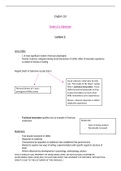
Regard Death of Salesman as play that is:
Social criticism: initial idea for title
was “The Inside of His Head”: points
Miler’s technical innovation - focus
Personal drama of 1 man:
shifts forward & backwards in time
protagonist Willy Loman
& play dramatizes as much what
Willy remembers as he experiences
Means: cohesion depends on Willy’s
subjective experience
- Technical innovation qualifies text as example of American
modernism Modernity:
- State of being modern
- Perpetually renewed
Modernism:
- Time bound movement of 1900s
- Response to modernity
- Characterized by opposition to traditional rules established that governed arts
- Wanted to explore new ways of writing: experimentation (with specific regard to structure of
texts)
- Writers influenced by developments in psychology, anthropology, physics
THIS IS INTELLECTUAL PROPERTY OF JENNA ROSE LOPES- DO NOT ILLEGALLY DISTRIBUTE.
(SUMMARIES MADE USING ENG 210 LECTURES FROM THE UNIVERSITY OF PRETORIA: INTELLECTUAL
CREDIT IS DUE TO THE LECTURERS OF THIS MODULE.)
, - Difficult to read: due to experimental nature of work
Formal characteristics of modernism:
(relating to Death of a Salesman)
- Disrupted narrative: no chronological order
- Stream-of-consciousness: capture flow of thoughts of character (past & present meeting in
particular consciousness)
- Subjectivism: convict that knowledge is subject; filtered through mind of individual
- Fragmentation: result of subjectivism
Thematic characteristics of modernism:
- Focus on individual experience
- Interest in capturing nature of human perception, representing workings of mind (in case of this
play: malfunctioning of mind)
- Uncertainty of future
- Problems of language & communication: Biff & Willy talk at cross purposes
- Synchronic view of time: dealing with something as it exists at 1 point in time, not over
extended period, (play takes place over 24 hours)
- Disillusionment: focus on illusions Willy resorts to in order to cover his disillusionment, as well
as how does Biff react to his own disillusionment & illusions of Willy
- Preoccupation with urban life: Willy complains about boxed in existence in urban society
Concept of American dream:
- Idea that regardless of background: through hard work able to become successful & achieved
desired life
- Preoccupied with overcoming difficulties & gaining prosperity
- Willy Loman: both product & victim of society- he has accepted all surface level values of
American society as gospel & is in pursuit of elusive of “American dream” which is in fact
corrupt
- Failure threatens identity
- Miller explores what happens to family of Loman’s as are trapped in miserable system that
promises happiness & freedom
- Loman’s fail to realize that they are in space of ruthless competition, in order to function this
system thrives on inequality
Act 1:
Opening scene:
THIS IS INTELLECTUAL PROPERTY OF JENNA ROSE LOPES- DO NOT ILLEGALLY DISTRIBUTE.
(SUMMARIES MADE USING ENG 210 LECTURES FROM THE UNIVERSITY OF PRETORIA: INTELLECTUAL
CREDIT IS DUE TO THE LECTURERS OF THIS MODULE.)


