Chemical Bonding
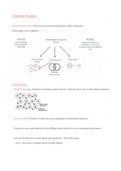
Intramolecular bond: Bond that occurs between atoms within molecules
What keeps them together:
Type of bonds:
• Metallic bonding: Attraction between positive atomic residues and a sea of delocalised electrons
• Ionic bonding: Transfer of electrons and subsequent electrostatic attraction
Metal and non-metal elements bond (Metal loses electrons & non-metal gains electrons)
Ions are formed and crystal lattice are produced - Giant structures
+ and - ions pack in regular lattice (crystal lattice)
, - Ionic crystals are brittle
- Ionic crystals don't conduct electricity
- Ionic substances can conduct electricity in molten state or when
dissolved: Ions (charges) become mobile
• Covalent bonding: Sharing of at least one pair of electrons by two non-metal atoms (molecules
formed)
Molecules are small groups of atoms, but sometimes (diamond, C ; graphite, C and quartz sand
SiO2) Giant molecules are formed = network covalent structures
Lewis structure: Symbol of element with dots representing valence electrons
4 types of covalent bonds:
1. Single covalent bond:
2. Double covalent bond:
Intramolecular bond: Bond that occurs between atoms within molecules
What keeps them together:
Type of bonds:
• Metallic bonding: Attraction between positive atomic residues and a sea of delocalised electrons
• Ionic bonding: Transfer of electrons and subsequent electrostatic attraction
Metal and non-metal elements bond (Metal loses electrons & non-metal gains electrons)
Ions are formed and crystal lattice are produced - Giant structures
+ and - ions pack in regular lattice (crystal lattice)
, - Ionic crystals are brittle
- Ionic crystals don't conduct electricity
- Ionic substances can conduct electricity in molten state or when
dissolved: Ions (charges) become mobile
• Covalent bonding: Sharing of at least one pair of electrons by two non-metal atoms (molecules
formed)
Molecules are small groups of atoms, but sometimes (diamond, C ; graphite, C and quartz sand
SiO2) Giant molecules are formed = network covalent structures
Lewis structure: Symbol of element with dots representing valence electrons
4 types of covalent bonds:
1. Single covalent bond:
2. Double covalent bond: