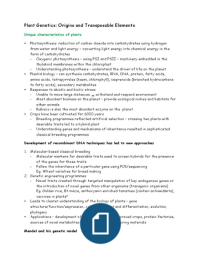
Plant Genetics: Origins and Transposable Elements
Unique characteristics of plants
Photosynthesis: reduction of carbon dioxide into carbohydrates using hydrogen
from water and light energy – converting light energy into chemical energy in the
form of carbohydrates
- Oxygenic photosynthesis – using PSI and PSII – machinery embedded in the
thylakoid membranes within the chloroplast
- Understanding photosynthesis – understand the driver of life on the planet
Plastid biology – can synthesis carbohydrates, RNA, DNA, protein, fatty acids,
amino acids, tetrapyrroles (haem, chlorophyll), isoprenoids (branched hydrocarbons
to fatty acids), secondary metabolites
Responses to abiotic and biotic stress
- Unable to move large distances withstand and respond environment
- Most abundant biomass on the planet – provide ecological niches and habitats for
other animals
- Rubisco is also the most abundant enzyme on the planet
Crops have been cultivated for 6000 years
- Breeding programmes reflected artificial selection – crossing two plants with
desirable traits led to a hybrid plant
- Understanding genes and mechanisms of inheritance resulted in sophisticated
classical breeding programmes
Development of recombinant DNA techniques has led to new approaches
1. Molecular-based classical breeding
- Molecular markers for desirable traits used to screen hybrids for the presence
of the genes for those traits
- Follow the inheritance of a particular gene using PCR/sequencing
Eg. Wheat varieties for bread making
2. Genetic engineering programmes
- Novel traits created through targeted manipulation of key endogenous genes or
the introduction of novel genes from other organisms (transgenic organisms)
Eg. Golden rice, Bt maize, anthocyanin enriched tomatoes (contain antioxidants),
vaccines in plants?
Leads to clearer understanding of the biology of plants – gene
structure/function/expression, cell development and differentiation, evolution,
phylogeny
Applications – development of transgenic plants – improved crops, protein factories,
sources of novel metabolites as medicines, manufacturing materials
Mendel and his genetic model
, Chose appropriate model system of experiments for genetic inheritance – pea plants
1. Easy to grow – in gardens and pots
2. Grow in sufficient numbers for statistical analysis
3. Reproduce well and grows to maturity in a single season – 67-74 days to reach
maturity
4. Self-breeding: pea flowers tight, closed structures, preventing pollen entering
or leaving – self-breeding and show great genetic uniformity BUT
5. Easy to hybridise artificially – open up flowers, remove anthers before they
mature, then take mature anthers from another plant and fertilise the stigma
6. Choice of simple, scorable phenotypes depending on varieties – eg. seed shapes,
flower colour, stem length, pod colour, pod shape
Obtained a collection of true-breeding stocks showing distinct traits (chose 7
contrasting traits)
7. Pea has a diploid genome, traits do not show apparent genetic linkage
7 chromosomes – pod shape and plant height are tightly linked, but data not
published (1866)
No active transposons – phenotypes stable, dominance clear
Zea mays and transposable elements
Discovered TEs in maize – 1949 – showed that change of unstable recessive alleles
to dominant form in this plant was due to moveable
short segments of a chromosome (Barbara
McClintock)
Studied anthocyanin pigmentation among maize corn
kernels – water soluble pigments, primarily colour
dependent on pH
Mobile elements/transposition may ether cause
chromosome breaks (permanent mutant phenotype)
or inactivate genes (temporary – wt phenotype might
be subsequently restored in transposon migrates out
of the gene)
Ds/Ac system
- One allele on chr 9 responsible for colour (C
allele)
- CI allele is a dominant inhibitor of colouration
(if present – colourless)
- Cross of CC ears (female) to CiCi tassels
(males) to produce CCCi endosperm, then
mapped on chromosome 9
- Factor at the breakage point Ds (Dissociation) – Ds on its own is not able to
cause breakage
Unique characteristics of plants
Photosynthesis: reduction of carbon dioxide into carbohydrates using hydrogen
from water and light energy – converting light energy into chemical energy in the
form of carbohydrates
- Oxygenic photosynthesis – using PSI and PSII – machinery embedded in the
thylakoid membranes within the chloroplast
- Understanding photosynthesis – understand the driver of life on the planet
Plastid biology – can synthesis carbohydrates, RNA, DNA, protein, fatty acids,
amino acids, tetrapyrroles (haem, chlorophyll), isoprenoids (branched hydrocarbons
to fatty acids), secondary metabolites
Responses to abiotic and biotic stress
- Unable to move large distances withstand and respond environment
- Most abundant biomass on the planet – provide ecological niches and habitats for
other animals
- Rubisco is also the most abundant enzyme on the planet
Crops have been cultivated for 6000 years
- Breeding programmes reflected artificial selection – crossing two plants with
desirable traits led to a hybrid plant
- Understanding genes and mechanisms of inheritance resulted in sophisticated
classical breeding programmes
Development of recombinant DNA techniques has led to new approaches
1. Molecular-based classical breeding
- Molecular markers for desirable traits used to screen hybrids for the presence
of the genes for those traits
- Follow the inheritance of a particular gene using PCR/sequencing
Eg. Wheat varieties for bread making
2. Genetic engineering programmes
- Novel traits created through targeted manipulation of key endogenous genes or
the introduction of novel genes from other organisms (transgenic organisms)
Eg. Golden rice, Bt maize, anthocyanin enriched tomatoes (contain antioxidants),
vaccines in plants?
Leads to clearer understanding of the biology of plants – gene
structure/function/expression, cell development and differentiation, evolution,
phylogeny
Applications – development of transgenic plants – improved crops, protein factories,
sources of novel metabolites as medicines, manufacturing materials
Mendel and his genetic model
, Chose appropriate model system of experiments for genetic inheritance – pea plants
1. Easy to grow – in gardens and pots
2. Grow in sufficient numbers for statistical analysis
3. Reproduce well and grows to maturity in a single season – 67-74 days to reach
maturity
4. Self-breeding: pea flowers tight, closed structures, preventing pollen entering
or leaving – self-breeding and show great genetic uniformity BUT
5. Easy to hybridise artificially – open up flowers, remove anthers before they
mature, then take mature anthers from another plant and fertilise the stigma
6. Choice of simple, scorable phenotypes depending on varieties – eg. seed shapes,
flower colour, stem length, pod colour, pod shape
Obtained a collection of true-breeding stocks showing distinct traits (chose 7
contrasting traits)
7. Pea has a diploid genome, traits do not show apparent genetic linkage
7 chromosomes – pod shape and plant height are tightly linked, but data not
published (1866)
No active transposons – phenotypes stable, dominance clear
Zea mays and transposable elements
Discovered TEs in maize – 1949 – showed that change of unstable recessive alleles
to dominant form in this plant was due to moveable
short segments of a chromosome (Barbara
McClintock)
Studied anthocyanin pigmentation among maize corn
kernels – water soluble pigments, primarily colour
dependent on pH
Mobile elements/transposition may ether cause
chromosome breaks (permanent mutant phenotype)
or inactivate genes (temporary – wt phenotype might
be subsequently restored in transposon migrates out
of the gene)
Ds/Ac system
- One allele on chr 9 responsible for colour (C
allele)
- CI allele is a dominant inhibitor of colouration
(if present – colourless)
- Cross of CC ears (female) to CiCi tassels
(males) to produce CCCi endosperm, then
mapped on chromosome 9
- Factor at the breakage point Ds (Dissociation) – Ds on its own is not able to
cause breakage