Performance Quality
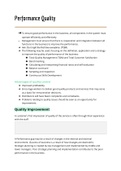
➔ To ensure good performance in the business, all components in the system must
operate efficiently and effectively.
➔ Management must ensure that there is cooperation and integration between all
functions in the business to improve the performance.
➔ Aim: Do it right the first time everytime. (TQM)
➔ The following may be used, focusing on the definition, application and a strategy
to improve the quality of performance of the business:
◆ Total Quality Management (TQM) and Total Customer Satisfaction
◆ Benchmarking
◆ Calculating and interpreting financial ratios and self evaluation
◆ Balance scorecard
◆ Sampling and inspection
◆ Continuous Skills Development
Advantages of quality control
➔ Improved profitability.
➔ Encourage workers to deliver good quality products and services that may serve
as a basis for remuneration decisions.
➔ Distributors will have fewer complaints and comebacks.
➔ Problems relating to quality issues should be seen as an opportunity for
improvement.
Quality Improvement
A customer's first impression of quality of the service is often through their experience
with the staff.
A Performance gap may be a result of changes in the internal and external
environment. (Success of business is a result of how changes are dealt with).
Strategic planning is created by top management and implemented by middle and
lower managers. Poor strategic planning and implementation contributes to the poor
performance in the business.
, To evaluate the performance of the business you will be looking at the Business
Functions.
General Management
➔ Strategic planning at top level management will fail to provide the business with
a future direction.
➔ If there is no support for the implementation of the plan from top management,
lower level management may not agree with the plan and will not completely
implement it.
◆ Can be improved by ensuring the plan is written and there is a common
understanding of what will be achieved.
➔ Strategic planning must ensure that current realities are not overlooked.
◆ Should aim at setting up future objectives but should be flexible and
adaptable to deal with current changes.
➔ Plans should be:
◆ Accurate and objective. (all factors should be considered)
◆ Realistic and economical.
◆ Should have an effective method of communication with workers and
supervisors.
➔ Must have a Plan B or contingency plan.
➔ KISS (keep it simple and straight).
➔ The plan must be detailed and must ensure there is a WHO and HOW the plan
will take place.
Human Resource/Human Capital
➔ HR functions can create an atmosphere of quality improvement through training
and coaching employees and other functional managers.
HR Roles
➔ To ensure good performance in the business, all components in the system must
operate efficiently and effectively.
➔ Management must ensure that there is cooperation and integration between all
functions in the business to improve the performance.
➔ Aim: Do it right the first time everytime. (TQM)
➔ The following may be used, focusing on the definition, application and a strategy
to improve the quality of performance of the business:
◆ Total Quality Management (TQM) and Total Customer Satisfaction
◆ Benchmarking
◆ Calculating and interpreting financial ratios and self evaluation
◆ Balance scorecard
◆ Sampling and inspection
◆ Continuous Skills Development
Advantages of quality control
➔ Improved profitability.
➔ Encourage workers to deliver good quality products and services that may serve
as a basis for remuneration decisions.
➔ Distributors will have fewer complaints and comebacks.
➔ Problems relating to quality issues should be seen as an opportunity for
improvement.
Quality Improvement
A customer's first impression of quality of the service is often through their experience
with the staff.
A Performance gap may be a result of changes in the internal and external
environment. (Success of business is a result of how changes are dealt with).
Strategic planning is created by top management and implemented by middle and
lower managers. Poor strategic planning and implementation contributes to the poor
performance in the business.
, To evaluate the performance of the business you will be looking at the Business
Functions.
General Management
➔ Strategic planning at top level management will fail to provide the business with
a future direction.
➔ If there is no support for the implementation of the plan from top management,
lower level management may not agree with the plan and will not completely
implement it.
◆ Can be improved by ensuring the plan is written and there is a common
understanding of what will be achieved.
➔ Strategic planning must ensure that current realities are not overlooked.
◆ Should aim at setting up future objectives but should be flexible and
adaptable to deal with current changes.
➔ Plans should be:
◆ Accurate and objective. (all factors should be considered)
◆ Realistic and economical.
◆ Should have an effective method of communication with workers and
supervisors.
➔ Must have a Plan B or contingency plan.
➔ KISS (keep it simple and straight).
➔ The plan must be detailed and must ensure there is a WHO and HOW the plan
will take place.
Human Resource/Human Capital
➔ HR functions can create an atmosphere of quality improvement through training
and coaching employees and other functional managers.
HR Roles