

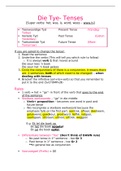
Die Tye- Tenses
[Super verbs: het, was, is, word, wees – www.hi]
Teenwoordige Tyd Present Tense (Vandag-
Today)
Verlede Tyd Past Tense (Gister-
Yesterday)
Toekomende Tyd Future Tense (More-
Tomorrow)
If you are asked to change the tense!
1. Read the sentence
2. Underline the verbs (This will tell you which rule to follow)
o It is always verb 1 that moves around
Die seun lees ‘n boek
Die seun het ‘n boek gelees
3. Circle the conjunctions (If there is a conjunction, it means there
are 2 sentences, both of which need to be changed) – when
dealing with tenses
4. Bracket the infinitive (om+te+verb) so that you remember to
put it to the end (Sv1TOMPv2I)
Rules
1 verb = het + “ge”- in front of the verb that goes to the end
of the sentence
Skeibare werkwoorde – “ge” in die middle
o Verb+ preposition – becomes one word in past and
future tense
o We recongnise a skeibare werkwoord because the
emphasis falls on the first part: aantrek, afhaal, deelneem,
gelukwens, goedkeur, grootword, liefhê, natgooi,
saamgaan, stilstaan, uitnooi, uittrek, weggooi
E.g. Ek tel die boek op
Ek het die boek opgetel
Ek sal die boek optel
Differentiate between “Toe” (Don’t think of DAWN rule)
o No past tense in 1st sentence – toe Gr 3
o Past tense in 1st sentence – toe Gr 2
**In general toe as conjunction
Voorvoegsel (Prefix) = GE
[Super verbs: het, was, is, word, wees – www.hi]
Teenwoordige Tyd Present Tense (Vandag-
Today)
Verlede Tyd Past Tense (Gister-
Yesterday)
Toekomende Tyd Future Tense (More-
Tomorrow)
If you are asked to change the tense!
1. Read the sentence
2. Underline the verbs (This will tell you which rule to follow)
o It is always verb 1 that moves around
Die seun lees ‘n boek
Die seun het ‘n boek gelees
3. Circle the conjunctions (If there is a conjunction, it means there
are 2 sentences, both of which need to be changed) – when
dealing with tenses
4. Bracket the infinitive (om+te+verb) so that you remember to
put it to the end (Sv1TOMPv2I)
Rules
1 verb = het + “ge”- in front of the verb that goes to the end
of the sentence
Skeibare werkwoorde – “ge” in die middle
o Verb+ preposition – becomes one word in past and
future tense
o We recongnise a skeibare werkwoord because the
emphasis falls on the first part: aantrek, afhaal, deelneem,
gelukwens, goedkeur, grootword, liefhê, natgooi,
saamgaan, stilstaan, uitnooi, uittrek, weggooi
E.g. Ek tel die boek op
Ek het die boek opgetel
Ek sal die boek optel
Differentiate between “Toe” (Don’t think of DAWN rule)
o No past tense in 1st sentence – toe Gr 3
o Past tense in 1st sentence – toe Gr 2
**In general toe as conjunction
Voorvoegsel (Prefix) = GE


