1
Advanced Programme Mathematics – Grade 12 Notes
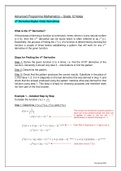
nth Derivative/Higher Order Derivatives
What is the nth Derivative?
If the process of deriving a function is continued 𝑛 times, where 𝑛 is any natural number
(𝑛 ∈ ℕ), then the 𝑛𝑡ℎ derivative can be found which is often referred to as 𝑓 𝑛 (𝑥).
Essentially, the process of finding the 𝑓 𝑛 (𝑥) of a function is determined by deriving the
function a couple of times before establishing a pattern that will work for any 𝑛𝑡ℎ
derivative of the given function.
Steps for Finding the nth Derivative
Step 1: Derive the given function 3 to 4 times, i.e. find the 3rd/4th derivative of the
function. Generally it should only take 3 - 4 derivations to find the pattern.
Step 2: Determine the pattern.
Step 3: Check that the pattern produces the correct results. Substitute in the place of
𝑛, the value 1, 2, 3 or 4 (depends on the last derivative that was derived in step 1) and
check that the answer produced using the pattern matches what was derived for that
function using step 1. This step is simply for checking purposes and therefore does
not form part of the final answer.
Example 1 – Detailed Step by Step
1
Consider the function 𝑓(𝑥) = 𝑥−1
Step 1: Determine 𝑓 ′ (𝑥), 𝑓 2 (𝑥), 𝑓 3 (𝑥) and 𝑓 4 (𝑥)
1 This function can be derived using the quotient or
𝑓(𝑥) =
𝑥−1 chain rule. In this worked example, the chain rule
is applied. In order to use the rule, 𝑥 − 1
∴ 𝑓(𝑥) = (𝑥 − 1)−1 (denominator) is raised to the power of −1.
𝑓 ′ (𝑥) = (−1)(𝑥 − 1)−2 = (−1)(𝑥 − 1)−(1+1) Chain Rule → 𝑫𝒙 [𝒇(𝒈(𝒙))] = 𝒇′ (𝒈(𝒙)). 𝒈′ (𝒙)
∴ 𝑓 ′ (𝑥) = −(𝑥 − 1)−2
𝑓 2 (𝑥) = (−1)(−2)(𝑥 − 1)−3 = (−1)(−2)(𝑥 − 1)−(2+1) = (−1)(−1)(1)(2)(𝑥 − 1)−(2+1)
∴ 𝑓 2 (𝑥) = 2(𝑥 − 1)−3 Used chain rule on 𝑓 ′ (𝑥)
Pia Eklund 2022
Advanced Programme Mathematics – Grade 12 Notes
nth Derivative/Higher Order Derivatives
What is the nth Derivative?
If the process of deriving a function is continued 𝑛 times, where 𝑛 is any natural number
(𝑛 ∈ ℕ), then the 𝑛𝑡ℎ derivative can be found which is often referred to as 𝑓 𝑛 (𝑥).
Essentially, the process of finding the 𝑓 𝑛 (𝑥) of a function is determined by deriving the
function a couple of times before establishing a pattern that will work for any 𝑛𝑡ℎ
derivative of the given function.
Steps for Finding the nth Derivative
Step 1: Derive the given function 3 to 4 times, i.e. find the 3rd/4th derivative of the
function. Generally it should only take 3 - 4 derivations to find the pattern.
Step 2: Determine the pattern.
Step 3: Check that the pattern produces the correct results. Substitute in the place of
𝑛, the value 1, 2, 3 or 4 (depends on the last derivative that was derived in step 1) and
check that the answer produced using the pattern matches what was derived for that
function using step 1. This step is simply for checking purposes and therefore does
not form part of the final answer.
Example 1 – Detailed Step by Step
1
Consider the function 𝑓(𝑥) = 𝑥−1
Step 1: Determine 𝑓 ′ (𝑥), 𝑓 2 (𝑥), 𝑓 3 (𝑥) and 𝑓 4 (𝑥)
1 This function can be derived using the quotient or
𝑓(𝑥) =
𝑥−1 chain rule. In this worked example, the chain rule
is applied. In order to use the rule, 𝑥 − 1
∴ 𝑓(𝑥) = (𝑥 − 1)−1 (denominator) is raised to the power of −1.
𝑓 ′ (𝑥) = (−1)(𝑥 − 1)−2 = (−1)(𝑥 − 1)−(1+1) Chain Rule → 𝑫𝒙 [𝒇(𝒈(𝒙))] = 𝒇′ (𝒈(𝒙)). 𝒈′ (𝒙)
∴ 𝑓 ′ (𝑥) = −(𝑥 − 1)−2
𝑓 2 (𝑥) = (−1)(−2)(𝑥 − 1)−3 = (−1)(−2)(𝑥 − 1)−(2+1) = (−1)(−1)(1)(2)(𝑥 − 1)−(2+1)
∴ 𝑓 2 (𝑥) = 2(𝑥 − 1)−3 Used chain rule on 𝑓 ′ (𝑥)
Pia Eklund 2022