OBS 124
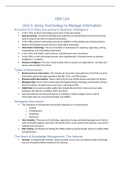
Unit 5: Using Technology to Manage Information
Evolution from Data processing to Business Intelligence
In the 1970s, business technology was known as data processing
Data processing: Included technology that supported an existing business and was primarily
used to improve the flow of financial information
In the 1980s, business technology was just an addition to the existing way of doing business.
Business technology became known as information technology
Information Technology: The set of methods or techniques for acquiring, organizing, storing,
manipulating, and transmitting information
In the 1990s, the WWW, online services, and Bluetooth were introduced
In the 2000s, as this technology became more sophisticated, it became known as business
intelligence or analytics
Business Intelligence: The use of data analytic tools to analyse an organization’s raw data and
derive useful insights from them
Types of Information
Business process information: This includes all transaction data gathered at the POS as well as
information gained through operations like ERP, SCM, and CRM systems
Physical-world observations: These result from the use of RFID devices and other IoT devices
Biological data: Forms of ID include improved fingerprinting technology and biometric devices
that scan retinas, recognize faces and voices, and analyse DNA
Public Data: Free and accessible, public data include the electronic traces we leave when
posting to the internet, sending e-mails, and more
Data that indicate personal preferences or intentions: Online shoppers leave a trail of
information that can reveal personal likes and dislikes
Managing Information
The usefulness of management information depends on 4 characteristics:
o Quality
o Completeness
o Timeliness
o Relevance
Data Analytics: The process of collecting, organising, storing, and analysing large sets of data in
order to identify patterns and other information that is most useful to the business now and for
making future decisions
Data mining: A technique for looking for hidden patterns and previously unknown relationships
among the data
The Heart of Knowledge Management: The Internet
Intranet: A companywide network, closed to public access, that uses Internet-type technology.
Can use a firewall to block intruders from entering.
Unit 5: Using Technology to Manage Information
Evolution from Data processing to Business Intelligence
In the 1970s, business technology was known as data processing
Data processing: Included technology that supported an existing business and was primarily
used to improve the flow of financial information
In the 1980s, business technology was just an addition to the existing way of doing business.
Business technology became known as information technology
Information Technology: The set of methods or techniques for acquiring, organizing, storing,
manipulating, and transmitting information
In the 1990s, the WWW, online services, and Bluetooth were introduced
In the 2000s, as this technology became more sophisticated, it became known as business
intelligence or analytics
Business Intelligence: The use of data analytic tools to analyse an organization’s raw data and
derive useful insights from them
Types of Information
Business process information: This includes all transaction data gathered at the POS as well as
information gained through operations like ERP, SCM, and CRM systems
Physical-world observations: These result from the use of RFID devices and other IoT devices
Biological data: Forms of ID include improved fingerprinting technology and biometric devices
that scan retinas, recognize faces and voices, and analyse DNA
Public Data: Free and accessible, public data include the electronic traces we leave when
posting to the internet, sending e-mails, and more
Data that indicate personal preferences or intentions: Online shoppers leave a trail of
information that can reveal personal likes and dislikes
Managing Information
The usefulness of management information depends on 4 characteristics:
o Quality
o Completeness
o Timeliness
o Relevance
Data Analytics: The process of collecting, organising, storing, and analysing large sets of data in
order to identify patterns and other information that is most useful to the business now and for
making future decisions
Data mining: A technique for looking for hidden patterns and previously unknown relationships
among the data
The Heart of Knowledge Management: The Internet
Intranet: A companywide network, closed to public access, that uses Internet-type technology.
Can use a firewall to block intruders from entering.