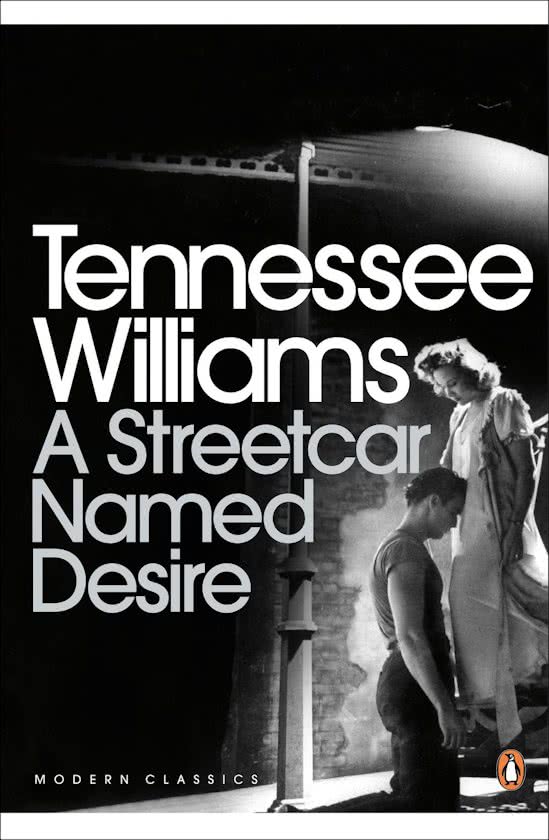
A Streetcar Named Desire, by Tennessee Williams, is a play that combats the notions of
falsity versus reality, specifically through viewing this as a living paradox of Blanche. The
exploration of this theme exposes desire to be a propagation of an illusion, as well as how
the progression of Blanche’s insanity originates from her antithetical persona, and finally the
juxtaposition in power between women and men, which contributes to the antithesis of
Blanche.
Blanche is viewed as a tragic hero throughout the play, as she fixates her entire self-worth
on her appearance to be lustful, however this monomania constructs deception and leads to
her downfall. The beginning of the play foreshadows this debasement through Blanche
“taking a streetcar named Desire, and then transfer[ing] to one called cemeteries… and
get[ting] off at – Elysian Fields” – a literal place of the setting in New Orleans, as well as a
figurative allusion to the Greek mythological resting place of fallen heroes, thus solidifying
her ruination as a result of her desire. Throughout the play, Blanche’s clothing is suggestive
of her ostensible purity, and is emphasised with her name meaning “white” in French –
perpetuating her innocence and virginity. She wears a “white satin evening gown… silver
slippers… rhinestone tiara” to correlate with her compulsive obsession to appear coy. In
reality, she wishes “to deceive [Mitch] enough to make him want [her]”, and ultimately
manipulates “[her] Rosenkavalier”, which represents male virtue through a heroic knight.
This clearly indicates that “her little weakness” is for people to “tell her she’s looking
wonderful” – hence exposing Blanche’s acquiesce of affirmation. Henceforth, the desire that
Blanche yearns for through the confirmation of others accentuates the need for manifesting
a façade, and villainizes this deception of the truth.
The anti-bildungsroman of Blanche’s character is manifested in the beginning the play as an
aristocrat of the Old America - representing generational wealth and veneration – however
transforms towards a downward moral journey into lunacy as she falls prey to her past.
There is a metaphor of Blanche, where “her white clothes suggest a moth”. Just as a moth
stays in darkness to heal, so too can Blanche not “stand a naked light bulb” due to her
subduing of her torment as she attempts to conceal her past and disguises the truth. The
music in the play progressively metastasizes Blanche’s insanity, where the “Varsouviana”
and “polka” music transport Blanche to the memory of Allan, and foregrounds her shame in
her inability to aid his guilt. This is transposed onto Blanche, where “[she] do[esn’t] want
realism, [she] want[s] magic” – alluding to the fictitious illusion that she has constructed.
Ultimately, she “slams the mirror face with such violence that the glass cracks”, which
exhibits her illusion of success in this New America – forgetting her past – and dissolves this
hope of escapism. Consequently, the juxtaposing positions of Blanche as an aristocrat and a
deranged individual evidence her internal dichotomy.
The disunion between Blanche and Stanley are synecdochic to the power disposition
between the women and men in the play, and ultimately label Blanche and the women as
destructive. Stanley wears “coloured shirts” which displays “men at the peak of their
physical manhood, as course and direct as powerful as the primary colours” in the setting of
a “poker party” – where women are observers to this and never participants. This exudes
the masculinity of propriety onto the women, where the men possess complete subjugation
and prevent any liberty of women. Contrarily, through the depiction of Blanche, she wears
“a white suit … necklace and earrings of pearl” – thus connoting to her purity and wealth,
falsity versus reality, specifically through viewing this as a living paradox of Blanche. The
exploration of this theme exposes desire to be a propagation of an illusion, as well as how
the progression of Blanche’s insanity originates from her antithetical persona, and finally the
juxtaposition in power between women and men, which contributes to the antithesis of
Blanche.
Blanche is viewed as a tragic hero throughout the play, as she fixates her entire self-worth
on her appearance to be lustful, however this monomania constructs deception and leads to
her downfall. The beginning of the play foreshadows this debasement through Blanche
“taking a streetcar named Desire, and then transfer[ing] to one called cemeteries… and
get[ting] off at – Elysian Fields” – a literal place of the setting in New Orleans, as well as a
figurative allusion to the Greek mythological resting place of fallen heroes, thus solidifying
her ruination as a result of her desire. Throughout the play, Blanche’s clothing is suggestive
of her ostensible purity, and is emphasised with her name meaning “white” in French –
perpetuating her innocence and virginity. She wears a “white satin evening gown… silver
slippers… rhinestone tiara” to correlate with her compulsive obsession to appear coy. In
reality, she wishes “to deceive [Mitch] enough to make him want [her]”, and ultimately
manipulates “[her] Rosenkavalier”, which represents male virtue through a heroic knight.
This clearly indicates that “her little weakness” is for people to “tell her she’s looking
wonderful” – hence exposing Blanche’s acquiesce of affirmation. Henceforth, the desire that
Blanche yearns for through the confirmation of others accentuates the need for manifesting
a façade, and villainizes this deception of the truth.
The anti-bildungsroman of Blanche’s character is manifested in the beginning the play as an
aristocrat of the Old America - representing generational wealth and veneration – however
transforms towards a downward moral journey into lunacy as she falls prey to her past.
There is a metaphor of Blanche, where “her white clothes suggest a moth”. Just as a moth
stays in darkness to heal, so too can Blanche not “stand a naked light bulb” due to her
subduing of her torment as she attempts to conceal her past and disguises the truth. The
music in the play progressively metastasizes Blanche’s insanity, where the “Varsouviana”
and “polka” music transport Blanche to the memory of Allan, and foregrounds her shame in
her inability to aid his guilt. This is transposed onto Blanche, where “[she] do[esn’t] want
realism, [she] want[s] magic” – alluding to the fictitious illusion that she has constructed.
Ultimately, she “slams the mirror face with such violence that the glass cracks”, which
exhibits her illusion of success in this New America – forgetting her past – and dissolves this
hope of escapism. Consequently, the juxtaposing positions of Blanche as an aristocrat and a
deranged individual evidence her internal dichotomy.
The disunion between Blanche and Stanley are synecdochic to the power disposition
between the women and men in the play, and ultimately label Blanche and the women as
destructive. Stanley wears “coloured shirts” which displays “men at the peak of their
physical manhood, as course and direct as powerful as the primary colours” in the setting of
a “poker party” – where women are observers to this and never participants. This exudes
the masculinity of propriety onto the women, where the men possess complete subjugation
and prevent any liberty of women. Contrarily, through the depiction of Blanche, she wears
“a white suit … necklace and earrings of pearl” – thus connoting to her purity and wealth,