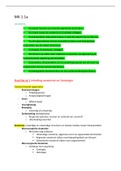
Strand 1 - Population Ecology
1. POPULATION ECOLOGY:
Ecology: The study of the interactions of organisms with their physical and biological environments
• Population ecology is concerned with the fluctuations in size of a population & factors that regulate
fluctuations.
• Individuals make up a population
• Populations make up communities
• Communities make up ecosystems (with non-living factors)
• Ecosystems make up biosphere
Biosphere: Part of earth where living organisms are found
Ecosystem: Groups of different species of organisms
Organism: Individual form of life
Community: Group of different species that interact in an area
Species: Group of closely related organisms capable of producing fertile offspring
Population: Group of organisms of the same species that occupy the same area at the same time
Population size:
Total number of individuals in a population
• Natality: birth rate
• Mortality: death rate
• Emigration: move out of (exit)
• Immigration: move into
(in a closed population, only natality & mortality affect size)
Population growth:
Individuals increase exponentially, therefore there are more demands on resources.
This causes environmental resistance, which causes birth rate & immigration to decrease and death
rate & emigration to increase.
Environmental Resistance: Total number of factors that stop a population from reproducing at a
maximum rate
, Eventually a balance is reached: Population stabilises. This is the carrying capacity.
Carrying Capacity: Population density that an environment can support
Population fluctuates around carrying capacity = self-regulating.
Limiting Factors: Build up environmental resistance
• Density Independent factors: (natural)
. - Physical factors eg. rainfall, temperature, humidity, acidity
- Catastrophic events eg. flood, fire, drought, volcano
• Density dependent factors:
- Competition
- Predators
- Disease
Stable & Unstable Populations:
• Stable: numbers decrease when size exceeds carrying capacity and increase when numbers fall
below capacity
• Unstable: Population exceeds carrying capacity:
- rapid deterioration of population & habitat
- cant support population = extinction
Estimation of population size:
• Direct methods;
Counting every individual = census. Used for:
- Populations with organisms large enough to be seen
- Where area is not too large
- Slow moving organisms eg. tortoise
- Stationary organisms eg. plants
- Organisms that usually stay in fixed position eg. barnacle
If the area is too large:
- Arial photographs eg. penguins/seals
- Helicopters eg. elephants/buffalo
1. POPULATION ECOLOGY:
Ecology: The study of the interactions of organisms with their physical and biological environments
• Population ecology is concerned with the fluctuations in size of a population & factors that regulate
fluctuations.
• Individuals make up a population
• Populations make up communities
• Communities make up ecosystems (with non-living factors)
• Ecosystems make up biosphere
Biosphere: Part of earth where living organisms are found
Ecosystem: Groups of different species of organisms
Organism: Individual form of life
Community: Group of different species that interact in an area
Species: Group of closely related organisms capable of producing fertile offspring
Population: Group of organisms of the same species that occupy the same area at the same time
Population size:
Total number of individuals in a population
• Natality: birth rate
• Mortality: death rate
• Emigration: move out of (exit)
• Immigration: move into
(in a closed population, only natality & mortality affect size)
Population growth:
Individuals increase exponentially, therefore there are more demands on resources.
This causes environmental resistance, which causes birth rate & immigration to decrease and death
rate & emigration to increase.
Environmental Resistance: Total number of factors that stop a population from reproducing at a
maximum rate
, Eventually a balance is reached: Population stabilises. This is the carrying capacity.
Carrying Capacity: Population density that an environment can support
Population fluctuates around carrying capacity = self-regulating.
Limiting Factors: Build up environmental resistance
• Density Independent factors: (natural)
. - Physical factors eg. rainfall, temperature, humidity, acidity
- Catastrophic events eg. flood, fire, drought, volcano
• Density dependent factors:
- Competition
- Predators
- Disease
Stable & Unstable Populations:
• Stable: numbers decrease when size exceeds carrying capacity and increase when numbers fall
below capacity
• Unstable: Population exceeds carrying capacity:
- rapid deterioration of population & habitat
- cant support population = extinction
Estimation of population size:
• Direct methods;
Counting every individual = census. Used for:
- Populations with organisms large enough to be seen
- Where area is not too large
- Slow moving organisms eg. tortoise
- Stationary organisms eg. plants
- Organisms that usually stay in fixed position eg. barnacle
If the area is too large:
- Arial photographs eg. penguins/seals
- Helicopters eg. elephants/buffalo