IEB: FURTHER STUDIES
MATHEMATICS (P1)
Module 1: SPLIT DOMAIN & COMPOSITE
FUNCTIONS
SPLIT DOMAIN FUNCTIONS
In a split domain function, different ‘rules’ apply to different parts of the domain. Use
the following approach to drawing graphs of split functions:
Indicate the boundaries with dotted lines.
For each interval determine and mark the endpoints at the boundaries; mark any
other important points within the interval (e.g. intercepts with axes, turning
points, etc.) and draw the graph.
Remember to use hollow dots for > and < and solid dots for ≥, ≤ and =
Reminder: For a function, each x-value has only ONE corresponding y-value.
COMPOSITE FUNCTIONS
The composite function f ∘ g(x) – read as “f circle g” or “f of g” – is defined by f(g(x))
📌 SUMMARY:
IEB: FURTHER STUDIES MATHEMATICS (P1) 1
, Module 2: TRIGONOMETRY
📌 SUMMARY:
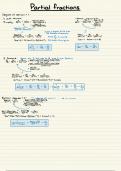
Module 3: PARTIAL FRACTIONS
INTRODUCTION DETERMINING PARTIAL
Rational algebraic fractions can be FRACTIONS
either proper or improper: In general use the following procedure:
Algebraic partial fractions only apply to
PROPER FRACTIONS (for improper
IEB: FURTHER STUDIES MATHEMATICS (P1) 2
, fractions first divide out and then
resolve the resulting proper fraction into
partial fractions if necessary).
COVER-UP METHOD
(only works for non-repeated linear
denominators)
…for determining the value of A , since
it is a partial fraction with a non-
repeated linear denominator.
📌 SUMMARY:
Module 4: POLYNOMIAL AND RATIONAL
INEQUALITIES
POLYNOMIAL INEQUALITIES RATIONAL INEQUALITIES
NB: For rational inequalities, DON’T
MULTIPLY THROUGH BY THE LCD.
Move everything to the LHS and put
everything over a common denominator
instead.
IEB: FURTHER STUDIES MATHEMATICS (P1) 3
MATHEMATICS (P1)
Module 1: SPLIT DOMAIN & COMPOSITE
FUNCTIONS
SPLIT DOMAIN FUNCTIONS
In a split domain function, different ‘rules’ apply to different parts of the domain. Use
the following approach to drawing graphs of split functions:
Indicate the boundaries with dotted lines.
For each interval determine and mark the endpoints at the boundaries; mark any
other important points within the interval (e.g. intercepts with axes, turning
points, etc.) and draw the graph.
Remember to use hollow dots for > and < and solid dots for ≥, ≤ and =
Reminder: For a function, each x-value has only ONE corresponding y-value.
COMPOSITE FUNCTIONS
The composite function f ∘ g(x) – read as “f circle g” or “f of g” – is defined by f(g(x))
📌 SUMMARY:
IEB: FURTHER STUDIES MATHEMATICS (P1) 1
, Module 2: TRIGONOMETRY
📌 SUMMARY:
Module 3: PARTIAL FRACTIONS
INTRODUCTION DETERMINING PARTIAL
Rational algebraic fractions can be FRACTIONS
either proper or improper: In general use the following procedure:
Algebraic partial fractions only apply to
PROPER FRACTIONS (for improper
IEB: FURTHER STUDIES MATHEMATICS (P1) 2
, fractions first divide out and then
resolve the resulting proper fraction into
partial fractions if necessary).
COVER-UP METHOD
(only works for non-repeated linear
denominators)
…for determining the value of A , since
it is a partial fraction with a non-
repeated linear denominator.
📌 SUMMARY:
Module 4: POLYNOMIAL AND RATIONAL
INEQUALITIES
POLYNOMIAL INEQUALITIES RATIONAL INEQUALITIES
NB: For rational inequalities, DON’T
MULTIPLY THROUGH BY THE LCD.
Move everything to the LHS and put
everything over a common denominator
instead.
IEB: FURTHER STUDIES MATHEMATICS (P1) 3