
LEARNING UNIT 7
Urbanisation and Urban Problems in the
Less Developed Countries
7.1 INTRODUCTION
Rapid urbanization in many less developed countries has created a host of problems for urban residents
and weakened the role of cities as engines of economic growth (Knox & McCarthy, 2014:189).
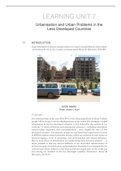
ADDIS ABABA.
Photo: André C Horn
To start with …
It is estimated that, in the year 2030, 80% of the urban population of about 5 billion
people will be living in the less developed part of the world. The challenge of rapid
urbanisation in the less developed countries is well defined by the authors of our
textbook: “A variety of historic and contemporary processes – including colonialism,
rural-to-urban migration, and overurbanization – have shaped the cities of less
developed countries. The patterns of land use and functional organization in cities
in different regions remain somewhat distinct, reflecting variations in such factors as
historical legacies, levels of technology, and environmental and cultural influences.
But the local effects of globalization are transforming these historical patterns … A
major problem is that the uneven diffusion of the networked infrastructures of
information and communications technologies has intensified social inequalities not
only between urban residents in the more and les developed parts of the world, but
also among city dwellers in the less developed countries themselves” (Knox &
McCarthy, 2014:159).
, 7.2 LEARNING OUTCOMES AND READING
LEARNING OUTCOMES
After working through all the prescribed study material for this Learning Unit,
you should be able to:
• Have a broad understanding of urbanisation in less developed countries
• Have a broad understanding of urban form and land use in different regions
in the less developed world
• Prepare reports on the most pressing urban development challenges in
South Africa and the remainder of the less developed world and propose
solutions in each case
• Critically discuss the spatial and sectoral interactions involving the urban
economies in less developed countries and the global economy
• Have a broad understanding of the planning and policy process in post-
apartheid South Africa
READING
• In order to achieve the above outcomes, you are required to read the
recommended reading material.
• NB: The information contained in the Study Guide alone will not be sufficient to
pass the examination for this module.
• For further enrichment you can also read: Pacione, M. 2009. Urban Geography.
London and New York: Routledge. (Chapters 21 to 29).
• You can also do further searches on the internet to enrich your knowledge.
7.3 LEARNING CONTENT
7.3.1 Urbanisation in the less developed countries
• Theories of Urbanisation and Economic Development
◦ Modernisation theories: the developmental approach – including Rostow’s
Stages of Economic Development Model and Friedmann’s core-periphery
model
◦ Urban bias and underdevelopment – including the ideas of Lipton, Frank,
Wallerstein
◦ Urban View 3: A model of peripheral Urbanisation
Urbanisation and Urban Problems in the
Less Developed Countries
7.1 INTRODUCTION
Rapid urbanization in many less developed countries has created a host of problems for urban residents
and weakened the role of cities as engines of economic growth (Knox & McCarthy, 2014:189).
ADDIS ABABA.
Photo: André C Horn
To start with …
It is estimated that, in the year 2030, 80% of the urban population of about 5 billion
people will be living in the less developed part of the world. The challenge of rapid
urbanisation in the less developed countries is well defined by the authors of our
textbook: “A variety of historic and contemporary processes – including colonialism,
rural-to-urban migration, and overurbanization – have shaped the cities of less
developed countries. The patterns of land use and functional organization in cities
in different regions remain somewhat distinct, reflecting variations in such factors as
historical legacies, levels of technology, and environmental and cultural influences.
But the local effects of globalization are transforming these historical patterns … A
major problem is that the uneven diffusion of the networked infrastructures of
information and communications technologies has intensified social inequalities not
only between urban residents in the more and les developed parts of the world, but
also among city dwellers in the less developed countries themselves” (Knox &
McCarthy, 2014:159).
, 7.2 LEARNING OUTCOMES AND READING
LEARNING OUTCOMES
After working through all the prescribed study material for this Learning Unit,
you should be able to:
• Have a broad understanding of urbanisation in less developed countries
• Have a broad understanding of urban form and land use in different regions
in the less developed world
• Prepare reports on the most pressing urban development challenges in
South Africa and the remainder of the less developed world and propose
solutions in each case
• Critically discuss the spatial and sectoral interactions involving the urban
economies in less developed countries and the global economy
• Have a broad understanding of the planning and policy process in post-
apartheid South Africa
READING
• In order to achieve the above outcomes, you are required to read the
recommended reading material.
• NB: The information contained in the Study Guide alone will not be sufficient to
pass the examination for this module.
• For further enrichment you can also read: Pacione, M. 2009. Urban Geography.
London and New York: Routledge. (Chapters 21 to 29).
• You can also do further searches on the internet to enrich your knowledge.
7.3 LEARNING CONTENT
7.3.1 Urbanisation in the less developed countries
• Theories of Urbanisation and Economic Development
◦ Modernisation theories: the developmental approach – including Rostow’s
Stages of Economic Development Model and Friedmann’s core-periphery
model
◦ Urban bias and underdevelopment – including the ideas of Lipton, Frank,
Wallerstein
◦ Urban View 3: A model of peripheral Urbanisation


