My Last Duchess
Robert Browning
By Adrian MacKenzie
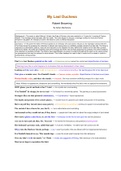
Background = The poem is about Alfonso Il d’esta, the Duke of Ferrara, who was married to a 14 year old, Lucrezia di Cosimo
Medici. This marriage ended abruptly after her death. The Duke began to discuss a marriage contract to marry the Roman
Emperor’s daughter. An emissary is sent to the Duke to carry out these discussion.
Summary = In this poem the Duke of Ferrara speaks to an emissary who was sent to discuss a new marriage contract with him.
The Duke shows the emissary his collection of artwork and among them is a skillfully painted portrait of his late wife. The Duke is
depicted as authoritative, jealous, insecure and impulsive as he explains the story behind the creation of his late wife’s portrait
before her death. He subtly and indirectly warns the emissary that if the new duchess disobeys his authority, she will be added to
the collection of duchess portraits. The Duke’s clear objectification of women is evident throughout the poem as he views women
as possessions that may be reduced to mere artwork. This further displays his need to feel in control as it is easier to control a
portrait than a living woman.
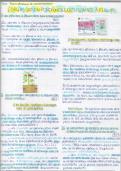
That’s my last Duchess painted on the wall, → Possessive pronoun assert his control and objectification of duchess
Warning tone (this is what happens to duchesses that are disobedient to their duke)
Looking as if she were alive. I call → Enjambment – conversational tone/flow. Her painting gives life to her dead soul.
That piece a wonder, now; Fra Pandolf’s hands → Caesura makes us ponder. Objectification of duchess as art piece
Worked busily a day, and there she stands.→ Innuendo. She was somehow skillfully portrayed for a day's work.
Note: Alfonso is oppressive, obsessive and controlling. He wondered what Fra did to her to capture her emotions.
Will’t please you sit and look at her? I said → He is polite but commanding
“Fra Pandolf” by design, for never read → Fra Pandolf is a renowned painter. The painting is a prized possession.
Strangers like you that pictured countenance, → Countenance = facial expressions
The depth and passion of its earnest glance, → wonder how he captured such depth and passion in the painting
But to myself they turned (since none puts by → Enjambment & parenthesis continue to support conversational flow
The curtain I have drawn for you, but I) → he is authoritative and controlling
And seemed as they would ask me, if they durst, → people don’t dare ask him about the origin/catalyst of such detail
How such a glance came there; so, not the first → emissary not the first to look upon her and her presence
Are you to turn and ask thus. Sir, ’twas not → he invites the emissary to ask questions (warning tone)
Her husband’s presence only, called that spot→ A sense of infidelity – he didn't have full control over her
Of joy into the Duchess’ cheek; perhaps → joy = wasn’t just polite. She was liberal with her inappropriate behaviour.
Fra Pandolf chanced to say, “Her mantle laps → even the monk wasn't exempt from this behaviour
Over my lady’s wrist too much,” or “Paint → wrists are suggestive of flirting. She’s desirous of an male attention.
Must never hope to reproduce the faint
Robert Browning
By Adrian MacKenzie
Background = The poem is about Alfonso Il d’esta, the Duke of Ferrara, who was married to a 14 year old, Lucrezia di Cosimo
Medici. This marriage ended abruptly after her death. The Duke began to discuss a marriage contract to marry the Roman
Emperor’s daughter. An emissary is sent to the Duke to carry out these discussion.
Summary = In this poem the Duke of Ferrara speaks to an emissary who was sent to discuss a new marriage contract with him.
The Duke shows the emissary his collection of artwork and among them is a skillfully painted portrait of his late wife. The Duke is
depicted as authoritative, jealous, insecure and impulsive as he explains the story behind the creation of his late wife’s portrait
before her death. He subtly and indirectly warns the emissary that if the new duchess disobeys his authority, she will be added to
the collection of duchess portraits. The Duke’s clear objectification of women is evident throughout the poem as he views women
as possessions that may be reduced to mere artwork. This further displays his need to feel in control as it is easier to control a
portrait than a living woman.
That’s my last Duchess painted on the wall, → Possessive pronoun assert his control and objectification of duchess
Warning tone (this is what happens to duchesses that are disobedient to their duke)
Looking as if she were alive. I call → Enjambment – conversational tone/flow. Her painting gives life to her dead soul.
That piece a wonder, now; Fra Pandolf’s hands → Caesura makes us ponder. Objectification of duchess as art piece
Worked busily a day, and there she stands.→ Innuendo. She was somehow skillfully portrayed for a day's work.
Note: Alfonso is oppressive, obsessive and controlling. He wondered what Fra did to her to capture her emotions.
Will’t please you sit and look at her? I said → He is polite but commanding
“Fra Pandolf” by design, for never read → Fra Pandolf is a renowned painter. The painting is a prized possession.
Strangers like you that pictured countenance, → Countenance = facial expressions
The depth and passion of its earnest glance, → wonder how he captured such depth and passion in the painting
But to myself they turned (since none puts by → Enjambment & parenthesis continue to support conversational flow
The curtain I have drawn for you, but I) → he is authoritative and controlling
And seemed as they would ask me, if they durst, → people don’t dare ask him about the origin/catalyst of such detail
How such a glance came there; so, not the first → emissary not the first to look upon her and her presence
Are you to turn and ask thus. Sir, ’twas not → he invites the emissary to ask questions (warning tone)
Her husband’s presence only, called that spot→ A sense of infidelity – he didn't have full control over her
Of joy into the Duchess’ cheek; perhaps → joy = wasn’t just polite. She was liberal with her inappropriate behaviour.
Fra Pandolf chanced to say, “Her mantle laps → even the monk wasn't exempt from this behaviour
Over my lady’s wrist too much,” or “Paint → wrists are suggestive of flirting. She’s desirous of an male attention.
Must never hope to reproduce the faint