Situation Ethics
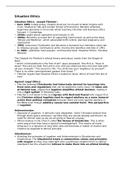
Situation Ethics - Joseph Fletcher:
• born 1905 in New Jersey. Parents divorced, he moved to West Virginia with
mum. Studied at Yale and London School of Economics. Became ordained,
beginning deanship in Cincinnati whilst teaching Christian and Business ethics
Harvard + Cambridge.
• 1930s: spoke about capitalism and industry in US.
• 1950s: McCarthy accused him of supporting Communism as well as the book
‘Morals and Medicine’, which advocated birth control, planned pregnancy and
sterilisation.
• 1960: renounces Christianity and becomes a humanist but maintains some ties
to religious groups. Continues to write, moving into bioethics and dies in 1991.
• In 1966 - publishes most popular, controversial book ‘Situation Ethics: The New
Morality’
The Catalyst for Fletcher’s ethical theory were Jesus’ words from the Gospel of
Mark:
““which commandment is the first of all?” Jesus answered, “the first is, “Hear O
Israel: The Lord our God, the Lord is one: and you shall love the Lord your God with
all your strength.” The second is this “You shall love your neighbour as yourself.”
There is no other commandment greater than these.””
• Fletcher argues that Situation Ethics is based on Jesus’ ethics of love/“the law of
love”
Against Legal Ethics:
• Fletcher believed Christianity had historically derived its teachings into
fixed rules and regulations that can be applied to every issue. He takes aim
at Natural Law, argues that legalism simplifies ethical decision, making it
into a rigid system of following rules.
• Fletcher is not alone in this and agrees with Bertrand Russel who argues that
the Christian ethical legalists tend to regard adultery as a more immoral
action than political corruption because there are rules against adultery in
the Bible even though adultery causes less societal harm. This perspective
= Legalism
Antinomianism:
• Opposite of Legalism, it removes rules altogether. Some Christians believe that
through God’s grace and Jesus’ sacrifice they are sacred already and there’s no
need for ethical rules as we are all going to Heaven anyway.
• Others believe in the Church called the heresy of Gnosticism. This is when
some argue that they have a special knowledge/right. This means all moral
behaviour is a rejection of long held rules and becomes a matter of instinct and
intuition as opposed to ethical principle.
Situationism:
• Avoiding the extremes of Legalism and Antinomianism is Situationism and
Situationists. The Situationist treats a communities values and principles
with respect as they may shed light onto a particular situation from a cultural
standpoint but the situationist refuses to make them into an ethical binding.
, • The situationist is prepared to set aside principles if it’s the right thing to
do.
• The right thing is always the self-sacrificing, neighbour-oriented, loving
thing.
• Fletcher uses Agape to describe the love at the heart of morality.
Love is a verb, not a noun:
• Christian situation ethics hold firmly that “value, worth, ethical quality,
goodness/badness, right/wrong - these things are only predicates, not
properties.”
• Fletcher says we must be clear: love is not a substance, it is a principle
which all Christians are called to.
• It’s the only universal value and Fletcher argues it’s not “something we have or
are but something we do.” We must act as to produce more good and that is love.
We must act in an optimific way - we should try to achieve the optimum love.
• Love does not say “be like me” but “do what you can where you are”.
Love is only substantive in God because God is love. We, however, are finite and
“only do love” trying in obedience to be like God.
• Love’s opposition is not hate but indifference.
• In Christian Situation Ethics nothing has value in and of itself. It derives its
value/lack of it from the fact that it helps or harms another person.
• Action which is right in one situation can be wrong in another.
• Fletcher determines that an acts rightness invariably depends on how it is related
to the circumstances surrounding it.
Low Relativism High Relativism
High Absolutists: Principled idealists who Situationists: Idealistic
Idealism believe people should act in ways contextualists who favour securing
that are consistent with moral rules, the best possible consequences for all
for doing so will in most cases yield concerned even if doings so will
the best outcomes for all concerned. violate traditional rules that define
what is right and what is wrong.
Low Exceptionists: Principled Subjectivists: Pragmatic relativists
Idealism pragmatists who endorse moral rules who base their ethical choices on
as guides for action, but admit that personal considerations, such as
following rules will not necessarily individualised values, moral emotions
generate the best consequences for or an idiosyncratic moral philosophy.
all concerned.
• Agape:
• Fletcher stressed agape was the only universal rule.
• “the situationist follows a moral law or violates it according to love’s need.”
• Fletcher is an absolutist regarding love, but a relativist regarding an
action. Richard Jacobs (situationist) describes this as a “principled relativism”
Situation Ethics - Joseph Fletcher:
• born 1905 in New Jersey. Parents divorced, he moved to West Virginia with
mum. Studied at Yale and London School of Economics. Became ordained,
beginning deanship in Cincinnati whilst teaching Christian and Business ethics
Harvard + Cambridge.
• 1930s: spoke about capitalism and industry in US.
• 1950s: McCarthy accused him of supporting Communism as well as the book
‘Morals and Medicine’, which advocated birth control, planned pregnancy and
sterilisation.
• 1960: renounces Christianity and becomes a humanist but maintains some ties
to religious groups. Continues to write, moving into bioethics and dies in 1991.
• In 1966 - publishes most popular, controversial book ‘Situation Ethics: The New
Morality’
The Catalyst for Fletcher’s ethical theory were Jesus’ words from the Gospel of
Mark:
““which commandment is the first of all?” Jesus answered, “the first is, “Hear O
Israel: The Lord our God, the Lord is one: and you shall love the Lord your God with
all your strength.” The second is this “You shall love your neighbour as yourself.”
There is no other commandment greater than these.””
• Fletcher argues that Situation Ethics is based on Jesus’ ethics of love/“the law of
love”
Against Legal Ethics:
• Fletcher believed Christianity had historically derived its teachings into
fixed rules and regulations that can be applied to every issue. He takes aim
at Natural Law, argues that legalism simplifies ethical decision, making it
into a rigid system of following rules.
• Fletcher is not alone in this and agrees with Bertrand Russel who argues that
the Christian ethical legalists tend to regard adultery as a more immoral
action than political corruption because there are rules against adultery in
the Bible even though adultery causes less societal harm. This perspective
= Legalism
Antinomianism:
• Opposite of Legalism, it removes rules altogether. Some Christians believe that
through God’s grace and Jesus’ sacrifice they are sacred already and there’s no
need for ethical rules as we are all going to Heaven anyway.
• Others believe in the Church called the heresy of Gnosticism. This is when
some argue that they have a special knowledge/right. This means all moral
behaviour is a rejection of long held rules and becomes a matter of instinct and
intuition as opposed to ethical principle.
Situationism:
• Avoiding the extremes of Legalism and Antinomianism is Situationism and
Situationists. The Situationist treats a communities values and principles
with respect as they may shed light onto a particular situation from a cultural
standpoint but the situationist refuses to make them into an ethical binding.
, • The situationist is prepared to set aside principles if it’s the right thing to
do.
• The right thing is always the self-sacrificing, neighbour-oriented, loving
thing.
• Fletcher uses Agape to describe the love at the heart of morality.
Love is a verb, not a noun:
• Christian situation ethics hold firmly that “value, worth, ethical quality,
goodness/badness, right/wrong - these things are only predicates, not
properties.”
• Fletcher says we must be clear: love is not a substance, it is a principle
which all Christians are called to.
• It’s the only universal value and Fletcher argues it’s not “something we have or
are but something we do.” We must act as to produce more good and that is love.
We must act in an optimific way - we should try to achieve the optimum love.
• Love does not say “be like me” but “do what you can where you are”.
Love is only substantive in God because God is love. We, however, are finite and
“only do love” trying in obedience to be like God.
• Love’s opposition is not hate but indifference.
• In Christian Situation Ethics nothing has value in and of itself. It derives its
value/lack of it from the fact that it helps or harms another person.
• Action which is right in one situation can be wrong in another.
• Fletcher determines that an acts rightness invariably depends on how it is related
to the circumstances surrounding it.
Low Relativism High Relativism
High Absolutists: Principled idealists who Situationists: Idealistic
Idealism believe people should act in ways contextualists who favour securing
that are consistent with moral rules, the best possible consequences for all
for doing so will in most cases yield concerned even if doings so will
the best outcomes for all concerned. violate traditional rules that define
what is right and what is wrong.
Low Exceptionists: Principled Subjectivists: Pragmatic relativists
Idealism pragmatists who endorse moral rules who base their ethical choices on
as guides for action, but admit that personal considerations, such as
following rules will not necessarily individualised values, moral emotions
generate the best consequences for or an idiosyncratic moral philosophy.
all concerned.
• Agape:
• Fletcher stressed agape was the only universal rule.
• “the situationist follows a moral law or violates it according to love’s need.”
• Fletcher is an absolutist regarding love, but a relativist regarding an
action. Richard Jacobs (situationist) describes this as a “principled relativism”