CIVIL RESISTANCE IN SA: 1970S TO 1980S
TOPIC 4
South Africa in the 1970s and 1980s was under the system of Apartheid - a system of
legalised segregation which protected white minority rule.
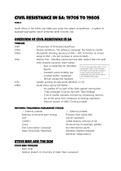
Overview of Civil Resistance in SA
TIMELINE:
1948 Introduction of formalised Apartheid
1950s Passive resistance, The defiance campaign, the freedom charter
1960s Sharpeville shooting, banning of ANC + PAC, formation of armed
wings of ANC + PA, but increase in police brutality
1964 Rivonia trial - Mandela imprisoned and ANC leaders flee into exile
1964 onwards becomes ‘silent sixties’
- Gap in leadership for liberation
figures
- Constant police brutality has
crushed further resistance
- African people feel hopeless
1976 Soweto uprising focuses world attention on SA
1980s South Africa led by PW Botha
- He justifies AP as part of the fight against communism
- “Total onslaught’ must be met with “Total Strategy’
- Tries to soothe overseas criticism by introducing reforms,
but at the same time introduces increasing repression
- Rubicon speech of 1985 (Turning protest)
Reforms: Tricameral Parliament (1980s)
→ Internal protests → External protests
Business community want change Pressure from exiled ANC
UDF Call for sanctions
COSATU United Nations criticism of SA
Civics SA becoming increasingly isolated
End Conscription Campaign No international sports
Mass Democratic Movement Overseas investors withdrew
Namibian independence
Steve Biko and the BCM
Steve Biko Timeline
- Born 1946
- Medical student at University of Natal (Non-european)
, - Member of NUSAS (white dominated, multiracial organisation for students)
- 1968 broke away from NUSAS to form SASO
- SASO speak Black Consciousness thinking throughout ‘Black’ Universities
- Biko spreads philosophy to other areas
- 1973 banned by SA government
- 1977 murdered while detention
- American singer Peter Gabriel written tribute to Biko - song makes Biko even
more well-known
- Instead of silencing him the SA government had turned him into a martyr
Why did the government fear someone who was talking about keeping
races apart?
- Biko created Mass Movement - which went against whole Apartheid idea of
‘Divide and Rule’
- Biko encouraged ‘blacks’ to take stand against Apartheid
- He encouraged strike action and gave workers a sense of their own power
- He encouraged disinvestment
- He helped build Black solidarity
(Describing people as 'Indian’, ‘Ccoloured’,’Black’ or ‘White’ is racist terminology. This
terminology can only be used within historical context - can only be used when
referring to historical Aparthied classifications)
Black Consciousness:
- ‘Black’ included any of the oppressed races ( Indians and Coloured )
- Was a philosophy , an attitude and a way of life
- It aimed to conscientise black South Africans and instill in them the sense of self
worth and dignity which the Apartheid had systematically destroyed
- Encouraged black self-reliance - economic reliance and self-reliance in black
people achieving their own liberation
- Created pride in Black African heritage and culture
The spread of Black Consciousness
1972 Black People’s Convention -
an umbrella body for Black Consciousness groups
Its aim was to involve adults in the movement, to help break the silence and
hopelessness of the sixties. Self-help projects established
- Zanempilo Community Health clinic under Dr Mamphele Ramphele
- Mhloti Black Theatre, promoting balck culture
- Mjwaxa Leatherworks Project
- Zimele Trust Fund helped support political prisoners and their families
1972 Black Allied Workers Union -
TOPIC 4
South Africa in the 1970s and 1980s was under the system of Apartheid - a system of
legalised segregation which protected white minority rule.
Overview of Civil Resistance in SA
TIMELINE:
1948 Introduction of formalised Apartheid
1950s Passive resistance, The defiance campaign, the freedom charter
1960s Sharpeville shooting, banning of ANC + PAC, formation of armed
wings of ANC + PA, but increase in police brutality
1964 Rivonia trial - Mandela imprisoned and ANC leaders flee into exile
1964 onwards becomes ‘silent sixties’
- Gap in leadership for liberation
figures
- Constant police brutality has
crushed further resistance
- African people feel hopeless
1976 Soweto uprising focuses world attention on SA
1980s South Africa led by PW Botha
- He justifies AP as part of the fight against communism
- “Total onslaught’ must be met with “Total Strategy’
- Tries to soothe overseas criticism by introducing reforms,
but at the same time introduces increasing repression
- Rubicon speech of 1985 (Turning protest)
Reforms: Tricameral Parliament (1980s)
→ Internal protests → External protests
Business community want change Pressure from exiled ANC
UDF Call for sanctions
COSATU United Nations criticism of SA
Civics SA becoming increasingly isolated
End Conscription Campaign No international sports
Mass Democratic Movement Overseas investors withdrew
Namibian independence
Steve Biko and the BCM
Steve Biko Timeline
- Born 1946
- Medical student at University of Natal (Non-european)
, - Member of NUSAS (white dominated, multiracial organisation for students)
- 1968 broke away from NUSAS to form SASO
- SASO speak Black Consciousness thinking throughout ‘Black’ Universities
- Biko spreads philosophy to other areas
- 1973 banned by SA government
- 1977 murdered while detention
- American singer Peter Gabriel written tribute to Biko - song makes Biko even
more well-known
- Instead of silencing him the SA government had turned him into a martyr
Why did the government fear someone who was talking about keeping
races apart?
- Biko created Mass Movement - which went against whole Apartheid idea of
‘Divide and Rule’
- Biko encouraged ‘blacks’ to take stand against Apartheid
- He encouraged strike action and gave workers a sense of their own power
- He encouraged disinvestment
- He helped build Black solidarity
(Describing people as 'Indian’, ‘Ccoloured’,’Black’ or ‘White’ is racist terminology. This
terminology can only be used within historical context - can only be used when
referring to historical Aparthied classifications)
Black Consciousness:
- ‘Black’ included any of the oppressed races ( Indians and Coloured )
- Was a philosophy , an attitude and a way of life
- It aimed to conscientise black South Africans and instill in them the sense of self
worth and dignity which the Apartheid had systematically destroyed
- Encouraged black self-reliance - economic reliance and self-reliance in black
people achieving their own liberation
- Created pride in Black African heritage and culture
The spread of Black Consciousness
1972 Black People’s Convention -
an umbrella body for Black Consciousness groups
Its aim was to involve adults in the movement, to help break the silence and
hopelessness of the sixties. Self-help projects established
- Zanempilo Community Health clinic under Dr Mamphele Ramphele
- Mhloti Black Theatre, promoting balck culture
- Mjwaxa Leatherworks Project
- Zimele Trust Fund helped support political prisoners and their families
1972 Black Allied Workers Union -