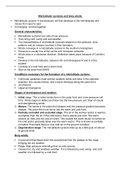
Mid-latitude cyclones and berg winds:
Mid-latitude cyclone: A low-pressure cell that develops in the mid-latitudes and
moves from west to east.
Converging: coming together.
General characteristics:
Mid-latitude cyclones are cells of low pressure.
They bring cold, windy and wet weather.
The characteristics of mid-latitude cyclones depend on the pressure, wind
patterns and air masses involved in their formation.
Winds converge in a mid-latitude cyclone in the southern hemisphere.
Pressure is usually low at the centre and increases outwards.
Winds blow in a clockwise direction. Deflection takes place because of Coriolis’s
force.
Develop in the mid-latitudes, between 40- and 60-degrees N and S of the
equator.
Consists of a cold front and a warm front.
Start at the polar front 60N/S
Conditions necessary for the formation of a mid-latitude cyclone:
Cold polar easterlies meet warmer westerly winds and blow in the opposite
direction- this causes friction, and a wave develops along the polar front.
Jet streams
Upper air divergence
Stages of development and weather:
1. Initial stage: This is when bends form in the polar front and a low-pressure cell
form. Winds begin to deflect and blow into the low-pressure cell. Start of clouds
and strengthening winds.
2. Mature: The bends in the polar front deepen and the pressure gradient becomes
steeper. The polar front now forms into the warm and cold front.
3. Partially occluded and occluded stage: The air in the warmer sector is warmer
and lighter than the air in the cold sector, that is dense and cold. The warm
sectors air rises and the cold air sinks. This causes the warm sector to narrow as
the cold sector gradually takes over the warm sector. This is known as partially
occluded. Eventually there is only cold air on the ground occluded.
4. Degeneration stage: The mid-latitude cyclone ends up as a little gust of cold air
at ground level.
Berg winds:
A local wind that blows down the escarpment from the plateau to the coast,
bringing hot dry weather.
Ridge: High pressure extending from an anti-cyclone.
Causes hot, dry and windless weather. If it is followed by wet, windy, and cold
weather it is followed by a cold front.
Mid-latitude cyclone: A low-pressure cell that develops in the mid-latitudes and
moves from west to east.
Converging: coming together.
General characteristics:
Mid-latitude cyclones are cells of low pressure.
They bring cold, windy and wet weather.
The characteristics of mid-latitude cyclones depend on the pressure, wind
patterns and air masses involved in their formation.
Winds converge in a mid-latitude cyclone in the southern hemisphere.
Pressure is usually low at the centre and increases outwards.
Winds blow in a clockwise direction. Deflection takes place because of Coriolis’s
force.
Develop in the mid-latitudes, between 40- and 60-degrees N and S of the
equator.
Consists of a cold front and a warm front.
Start at the polar front 60N/S
Conditions necessary for the formation of a mid-latitude cyclone:
Cold polar easterlies meet warmer westerly winds and blow in the opposite
direction- this causes friction, and a wave develops along the polar front.
Jet streams
Upper air divergence
Stages of development and weather:
1. Initial stage: This is when bends form in the polar front and a low-pressure cell
form. Winds begin to deflect and blow into the low-pressure cell. Start of clouds
and strengthening winds.
2. Mature: The bends in the polar front deepen and the pressure gradient becomes
steeper. The polar front now forms into the warm and cold front.
3. Partially occluded and occluded stage: The air in the warmer sector is warmer
and lighter than the air in the cold sector, that is dense and cold. The warm
sectors air rises and the cold air sinks. This causes the warm sector to narrow as
the cold sector gradually takes over the warm sector. This is known as partially
occluded. Eventually there is only cold air on the ground occluded.
4. Degeneration stage: The mid-latitude cyclone ends up as a little gust of cold air
at ground level.
Berg winds:
A local wind that blows down the escarpment from the plateau to the coast,
bringing hot dry weather.
Ridge: High pressure extending from an anti-cyclone.
Causes hot, dry and windless weather. If it is followed by wet, windy, and cold
weather it is followed by a cold front.