

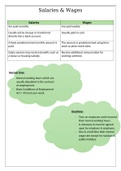
Salaries & Wages
Salaries Wages
Are paid monthly. Are paid weekly.
Usually aid by cheque or transferred Usually paid in cash.
directly into a bank account.
A fixed predetermined monthly amount is The amount is predetermined using time-
paid. work or piece-work rates.
Salary earners may receive benefits such as Receive additional remuneration for
a bonus or housing subsidy. working overtime.
Normal time:
- Normal working hours which are
usually stipulated in the contract
of employment.
- Basic Conditions of Employment
Act = 45 hours per week
Overtime:
- Time an employee works beyond
their normal working hours.
- Is voluntary & must be agreed
upon by employer & employee.
- One & a half time their normal
wage rate except for Sundays &
public holidays.
, Time-work & piece-work rates
Time-work rates: employees are paid an hourly rate for the number of hours worked;
this includes normal time & overtime.
Piece-work rates: employees are paid for each completed item, such as a basket of
fruit picked of a garment completed.
Salary scales:
- Predetermined future earnings of their employees.
- Normally based on employees’ qualification and/or years of experience.
- Usually start with a minimum salary that increases on an annual basis until the
maximum salary is reached.
- Salary levels = notches
- Starting salary = starting notch
Notch: R180 000 x R12 000 – R216 000 x R15 000 – R261 000
Year 1 2 3 4 5 6 7
Starting salary R180 000 R180 000 R192 000 R204 000 R216 000 R231 000 R246 000
(annual)
Increase - R12 000 R12 000 R12 000 R15 000 R15 000 R15 000
Maximum R180 000 R192 000 R204 000 R216 000 R231 000 R246 000 R261 000
annual salary
Deductions:
Deductions are payments that are made on behalf of the employee.
These deductions usually include:
Medical Aid Union
Pension fund UIF
Fund Membership Fees
Compulsory deductions:
PAYE
1. PAYE (Pay As You Earn)
Salaries Wages
Are paid monthly. Are paid weekly.
Usually aid by cheque or transferred Usually paid in cash.
directly into a bank account.
A fixed predetermined monthly amount is The amount is predetermined using time-
paid. work or piece-work rates.
Salary earners may receive benefits such as Receive additional remuneration for
a bonus or housing subsidy. working overtime.
Normal time:
- Normal working hours which are
usually stipulated in the contract
of employment.
- Basic Conditions of Employment
Act = 45 hours per week
Overtime:
- Time an employee works beyond
their normal working hours.
- Is voluntary & must be agreed
upon by employer & employee.
- One & a half time their normal
wage rate except for Sundays &
public holidays.
, Time-work & piece-work rates
Time-work rates: employees are paid an hourly rate for the number of hours worked;
this includes normal time & overtime.
Piece-work rates: employees are paid for each completed item, such as a basket of
fruit picked of a garment completed.
Salary scales:
- Predetermined future earnings of their employees.
- Normally based on employees’ qualification and/or years of experience.
- Usually start with a minimum salary that increases on an annual basis until the
maximum salary is reached.
- Salary levels = notches
- Starting salary = starting notch
Notch: R180 000 x R12 000 – R216 000 x R15 000 – R261 000
Year 1 2 3 4 5 6 7
Starting salary R180 000 R180 000 R192 000 R204 000 R216 000 R231 000 R246 000
(annual)
Increase - R12 000 R12 000 R12 000 R15 000 R15 000 R15 000
Maximum R180 000 R192 000 R204 000 R216 000 R231 000 R246 000 R261 000
annual salary
Deductions:
Deductions are payments that are made on behalf of the employee.
These deductions usually include:
Medical Aid Union
Pension fund UIF
Fund Membership Fees
Compulsory deductions:
PAYE
1. PAYE (Pay As You Earn)


