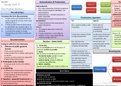
ECS 1601 Nationalisation & Privatisation Fisc
Nationalisation: • What the
• Gov. takes ownership of private companies budget)
- State owned companies (ESKOM) = not • What they
The role of Gov. nationalisation. • How they
- Nationalisation = transfer of private to EXPANSIONA
4 reasons for G in the economy: public ownership • If econom
1. Private sector and market forces can
Privatisation arguments
- Nationalisation leads to economic failure spend mo
produce goods & services much more Privatisation: For Against CONTRACTIO
effective than G • Private companies take ownership of • If econom
2. G helps private sector to do business public enterprises Gov = good in politics; bad There will not should spe
by upholding law, property rights, etc. Reason: in business necessarily be
3. G should try to correct market failures. 1. If G expense decrease, income tax competition resulting
4. G should force equity in society decrease in monopoly
(helping the poor) when markets are 2. Private ownership = more efficient Reasons for G
Privatisation attracts Direct G take stock of external
not fair. 3. Relieves G from some expenditures • Changing c
Foreign investments costs, Private firms do
(improve budget deficits) • Political &
not (pollution, etc)
Gov intervention • Redistribu
Taxation – Adam Smith Gov will have less Private firms not • Misconcep
5 ways in which G can intervene expenditures and private concerned with society • Population
1. Neutrality: company will pay taxes. at large (reducing
1. Delivery of public goods &
Tax should disturb prices & allocation of poverty)
Service resources as little as possible
• Public owned and financed 2. Equity Private companies can Financing Gov S
• G pays private firm to deliver public good Tax should be spread fairly across society change and adopt easily to
or service • Horizontal equity: people in same economic circumstances
• G teams up with private firm called PPP position pay the same tax Gov will have more to
(Public Private Partnership) • Vertical equity: people in different spend on education,
2. Participate in the market. positions pay differently service delivery, etc
• G buys goods & service and employs 3. Admin simplicity
people Should not be difficult or costly to collect tax Instrument for BEE (black
3. G spending economic empowerment)
• G influences economy when they decide Gov Failure
to buy, G can make transfer payments
(make payment without receiving Politicians can fail:
anything in return) • Goal = to be re-elected
4. Taxation = powerful instrument. E.g. (Popularity vs what is right)
if G wants more equal distribution they tax • Long term goals vs short term (want votes – now!)
rich more and poor less. Bureaucrats can fail:
Nationalisation: • What the
• Gov. takes ownership of private companies budget)
- State owned companies (ESKOM) = not • What they
The role of Gov. nationalisation. • How they
- Nationalisation = transfer of private to EXPANSIONA
4 reasons for G in the economy: public ownership • If econom
1. Private sector and market forces can
Privatisation arguments
- Nationalisation leads to economic failure spend mo
produce goods & services much more Privatisation: For Against CONTRACTIO
effective than G • Private companies take ownership of • If econom
2. G helps private sector to do business public enterprises Gov = good in politics; bad There will not should spe
by upholding law, property rights, etc. Reason: in business necessarily be
3. G should try to correct market failures. 1. If G expense decrease, income tax competition resulting
4. G should force equity in society decrease in monopoly
(helping the poor) when markets are 2. Private ownership = more efficient Reasons for G
Privatisation attracts Direct G take stock of external
not fair. 3. Relieves G from some expenditures • Changing c
Foreign investments costs, Private firms do
(improve budget deficits) • Political &
not (pollution, etc)
Gov intervention • Redistribu
Taxation – Adam Smith Gov will have less Private firms not • Misconcep
5 ways in which G can intervene expenditures and private concerned with society • Population
1. Neutrality: company will pay taxes. at large (reducing
1. Delivery of public goods &
Tax should disturb prices & allocation of poverty)
Service resources as little as possible
• Public owned and financed 2. Equity Private companies can Financing Gov S
• G pays private firm to deliver public good Tax should be spread fairly across society change and adopt easily to
or service • Horizontal equity: people in same economic circumstances
• G teams up with private firm called PPP position pay the same tax Gov will have more to
(Public Private Partnership) • Vertical equity: people in different spend on education,
2. Participate in the market. positions pay differently service delivery, etc
• G buys goods & service and employs 3. Admin simplicity
people Should not be difficult or costly to collect tax Instrument for BEE (black
3. G spending economic empowerment)
• G influences economy when they decide Gov Failure
to buy, G can make transfer payments
(make payment without receiving Politicians can fail:
anything in return) • Goal = to be re-elected
4. Taxation = powerful instrument. E.g. (Popularity vs what is right)
if G wants more equal distribution they tax • Long term goals vs short term (want votes – now!)
rich more and poor less. Bureaucrats can fail: